AI estimate as of November 5, 2025 · verify with a professional before acting
AI-Generated · Verify before acting
Everything on this page is generated by AI for informational purposes only. AI can make mistakes — the AI may misidentify items or misattribute them (artist, maker, brand, designer, origin, era). This is not an official valuation and should not be used for insurance, sale, tax, estate, legal, or lending purposes — or any decision requiring a certified appraisal. It is not an authoritative claim about any person, brand, or rights holder — do not share or rely on it as a factual statement about a third party. Always consult qualified professionals before making financial decisions.
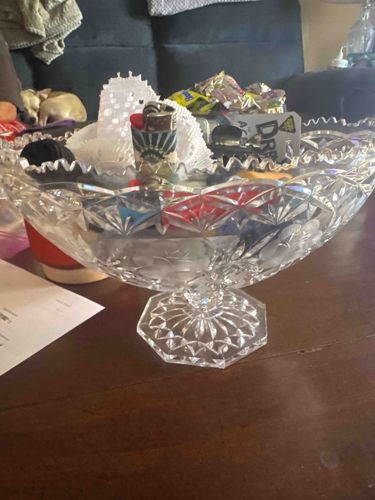
This item is a decorative fruit bowl, crafted from what appears to be cut crystal or heavy pressed glass, supported by a short pedestal base. The bowl itself is oval or oblong in shape, featuring a wide, scalloped rim that exhibits alternating wave-like undulations. The exterior surface of the bowl is highly faceted with a diamond-cut pattern, which, typical of cut crystal, enhances light refraction and gives it a sparkling appearance. Internally, the bowl contains various objects, including what looks like candy wrappers and a lighter, indicating its current use as a general receptacle. The pedestal base is hexagonal in shape and also features a complementary cut pattern, likely a starburst or geometric design, adding to its stability and aesthetic appeal. The clear material suggests it could be lead crystal due to its brilliance, but without tactile examination for weight and specific clarity tests, it's difficult to confirm definitively between high-quality pressed glass and true cut crystal. There are no visible chips, cracks, or significant wear affecting the clarity or functionality of the bowl that can be discerned from the image, suggesting it is in good, used condition. The style is classic and ornate, often associated with mid-20th century to contemporary decorative glass or crystal production. The craftsmanship, indicated by the precise cutting and symmetrical design, suggests a piece intended for display and formal use.
AI Appraisal Report
Based on my visual examination of the image provided, this Cut Crystal Pedestal Fruit Bowl presents as a well-maintained piece of decorative glassware. The broad, scalloped rim and deeply faceted diamond-cut pattern are characteristic of mid-20th century to contemporary crystal or high-quality pressed glass. The hexagonal pedestal base with its complementary cut pattern further enhances its aesthetic appeal and stability. I observe no visible chips, cracks, or significant wear that would detract from its overall clarity or presentation, indicating it is in good, used condition. While its current use as a general receptacle for candy wrappers and a lighter is noted, this does not affect the intrinsic value of the item itself.
Authenticity verification, however, is limited by image-based assessment. The brilliance captured in the photograph suggests lead crystal, but without tactile examination for weight, resonance, and specific clarity tests under magnification, I cannot definitively confirm it as true cut lead crystal versus high-quality pressed glass. The term “cut crystal” is often generically used, and discerning genuine lead crystal from finely pressed glass requires physical inspection.
Market conditions for such decorative crystal or pressed glass fruit bowls are generally moderate. While once highly prized, the demand for ornate crystal pieces has somewhat softened, making them readily available in secondary markets. Comparables, usually found in antique shops, estate sales, or online marketplaces, typically range depending on the maker, material confirmation, and condition. Rarity is not a significant factor here; similar styles are common.
Factors impacting value significantly include authentication of material (lead crystal vs. pressed glass), the reputation of the manufacturer (if identifiable, e.g., Waterford, Baccarat, etc., which is not ascertainable from the image), and the absence of any damage not visible. To fully authenticate and maximize the valuation, an in-person examination, potentially including specific gravity tests for lead content and examination of the cutting techniques, would be necessary. Any manufacturer's marks or provenance documentation would also greatly assist in a more precise appraisal. Without these, the value remains conservative.