AI Appraisal Estimate

AI-generated estimates · not official valuations

From the user

What was submitted

Photo and notes provided by the user — not generated by AI

Submitted item photo
Submitted photo · June 24, 2026

User's notes

No additional notes provided.

AI analysis below

AI appraisal

AI analysis & estimate

AI-Generated · Verify before acting

Everything below is generated by AI for informational purposes only. AI can make mistakes — the AI may misidentify items or misattribute them (artist, maker, brand, designer, origin, era). This is not an official valuation and should not be used for insurance, sale, tax, estate, legal, or lending purposes — or any decision requiring a certified appraisal. It is not an authoritative claim about any person, brand, or rights holder — do not share or rely on it as a factual statement about a third party. Always consult qualified professionals before making financial decisions.

Read the full disclaimer

AI Identification

·Not independently authenticated·Verify before acting

Vintage Silvertone Portable Automatic Record Changer

Vintage Audio Equipment / Mid-Century Electronics

AI Estimated Value

·Not an official valuation·Verify before acting

$40.00 - $75.00

As of June 24, 2026

AI Item Analysis

·AI can make mistakes·Verify before acting
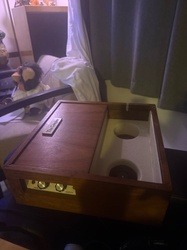
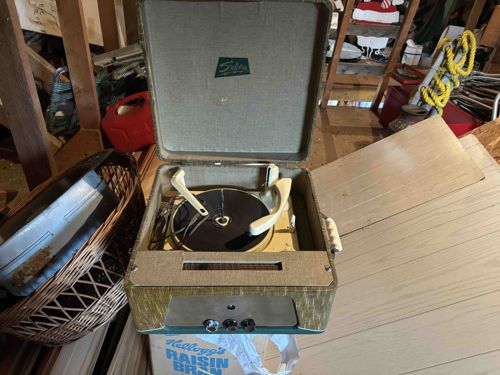
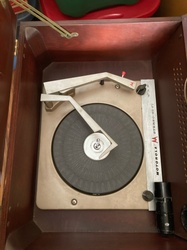
This is a mid-century vintage portable record player manufactured by Silvertone, a brand historically associated with Sears, Roebuck and Co. The unit is housed in a suitcase-style carrying case featuring a textured green and tan tweed or 'linen' style fabric covering that was common in the 1950s. The interior of the lid displays a green triangular 'Silvertone' logo. The mechanism features a cream-colored plastic tonearm and a matching record stabilizer arm, indicating it is an automatic changer capable of playing multiple stacked vinyl records. The platter is dark, likely rubber or felt-covered metal, and is currently holding a 45 RPM or small LP record. On the front of the unit, there is a metal control panel with three dark knobs for power/volume and tone adjustments, along with a front-facing speaker grille covered in fabric. The overall construction reflects the consumer-grade electronic standards of the post-WWII era, intended for home entertainment and portability. Condition-wise, the item shows significant signs of age and storage wear. There is visible staining on the interior lid fabric, surface dust throughout, and some fraying or scuffing on the exterior case edges. The record currently on the platter appears warped or damaged. While the mechanical components seem intact, the electrical wiring and internal vacuum tubes or early transistors would require professional inspection to determine functionality, as the insulation on older power cords often becomes brittle and hazardous over time.
AI Appraisal Report

·AI can make mistakes·Verify before acting
I have examined the provided images of this Silvertone portable automatic record changer, likely a Model 12 or 13 from the early 1950s. The unit features the iconic 'linen' tweed styling and quintessential mid-century atomic triangular logo characteristic of Sears, Roebuck & Co. products of that era. Physically, the item appears to be an authentic survivor, though it exhibits significant cosmetic deterioration. I noted prominent staining on the interior lid, surface oxidation on the control panel, and expected fraying on the exterior casing. These condition factors significantly suppress the value for serious audio collectors. The current market for vintage Silvertone portables is driven more by aesthetic 'props' or DIY restoration enthusiasts rather than audiophiles. Higher-end brands like KLH or Marantz command premium prices, whereas Silvertone was a budget-friendly consumer brand. While these are not 'rare' in a global sense, finding them with intact stabilizer arms and original knobs adds some value. However, the likely brittle wiring and degraded vacuum tube capacitors pose a fire hazard, meaning the unit is currently in 'untested/as-is' condition. Final valuation is limited by the inability to physically inspect the motor, stylus, and internal transformer. I cannot verify if the turntable maintains a steady RPM or if the amplifier produces sound without hum. A full authentication would require opening the chassis to inspect for original components versus aftermarket repairs, testing the vacuum tubes on a calibrated tester, and checking for cabinet rot. Without a functional demonstration, this remains a restoration project or decorative piece rather than a functional piece of high-fidelity equipment.

Get your items appraised

Instant estimates of your treasures with AI-powered appraisals

Browse More Appraisals