AI estimate as of October 18, 2025 · verify with a professional before acting
AI-Generated · Verify before acting
Everything on this page is generated by AI for informational purposes only. AI can make mistakes — the AI may misidentify items or misattribute them (artist, maker, brand, designer, origin, era). This is not an official valuation and should not be used for insurance, sale, tax, estate, legal, or lending purposes — or any decision requiring a certified appraisal. It is not an authoritative claim about any person, brand, or rights holder — do not share or rely on it as a factual statement about a third party. Always consult qualified professionals before making financial decisions.
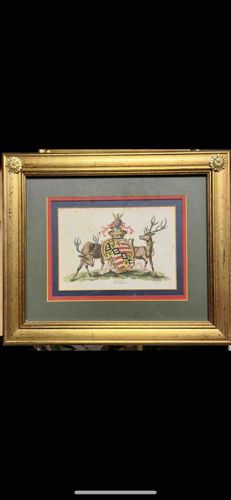
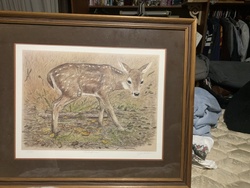
This item is a framed hand-colored engraving depicting a coat of arms flanked by two deer, a stag on the right and a hind or smaller deer on the left, serving as supporters. The central heraldic shield is multi-quartered and features various charges in red, gold, black, and white/silver. Above the shield, resting on an ornate helmet, is a crest, possibly a plume or small animal head, encircled by mantling in red and gold/yellow. The engraving itself is meticulously detailed, with visible fine lines typical of printmaking techniques, and has been carefully hand-colored in vibrant yet subtle hues, including greens for the ground, blues and reds for the borders and mantling, and naturalistic browns for the deer. The artwork is set within a triple matting arrangement: an inner thin red border, followed by a wider dark blue border, and finally a broad olive-green outer mat. This entire presentation is housed in a substantial, possibly gilded or gessoed, wooden frame. The frame features a classic profile with decorative corners, exhibiting a visible aged patina, some wear, and minor chipping to the gold finish, which suggests considerable age and handling. The corners are adorned with what appear to be carved or molded stylized rosettes or floral elements. The overall aesthetic points to an antique or vintage piece, likely from the 19th or early 20th century, given the style of heraldry and framing. The quality of the engraving and coloring indicates skilled craftsmanship, aiming for both accuracy and decorative appeal. No specific maker's marks or signatures are discernible from the image, but the piece presents as a high-quality decorative or collectible item.
AI Appraisal Report
I have examined the provided image of the framed hand-colored heraldic engraving with deer supporters. The overall presentation suggests a well-preserved antique or vintage piece, likely from the late 19th or early 20th century. The hand-coloring appears vibrant and thoughtfully applied, and the engraving itself shows fine detail. The triple matting and substantial, possibly gilded, wooden frame with decorative corners contribute significantly to its decorative appeal and perceived quality. The frame exhibits expected signs of age, including typical wear, minor chipping to the gold finish, and patina, which is consistent with its suggested age and does not detract significantly from its value; rather, it authenticates its antiquity.
Authenticity of the engraving as a period piece seems plausible based on style and apparent wear. Market conditions for decorative heraldic engravings of this type are generally moderate. While individual family crests can attract niche interest, generic or unidentified coats of arms like this one typically appeal to a broader decorative market. Comparables for well-framed, hand-colored antique engravings of decorative rather than historical significance range from $200-$600. The quality of the hand-coloring and the attractive, well-maintained frame elevate this piece within that range.
Factors impacting value include the skillful execution of the engraving and coloring, and the attractive, period-appropriate framing. Without specific heraldic identification, its rarity is limited to the quality of its production rather than its historical significance. Significant demand would come from collectors of decorative arts or those seeking period-appropriate decor.
My primary limitation in this appraisal is the lack of physical examination. I cannot verify the exact printing technique, paper quality, or true condition of the artwork beneath the frame without direct inspection. Furthermore, I cannot definitively confirm its age or rule out later reproductions without examining paper characteristics, potential watermarks, or printer's marks under magnification. In-person examination would allow for inspection for foxing, acid burn, or other condition issues that could affect value. Provenance documentation would be essential for establishing specific historical context or maker, which would significantly impact value. Without such specifics, this piece is valued primarily on its decorative merit and apparent quality. Scientific testing, if needed, would involve paper analysis or pigment analysis to confirm age and materials.