AI estimate as of September 30, 2025 · verify with a professional before acting
AI-Generated · Verify before acting
Everything on this page is generated by AI for informational purposes only. AI can make mistakes — the AI may misidentify items or misattribute them (artist, maker, brand, designer, origin, era). This is not an official valuation and should not be used for insurance, sale, tax, estate, legal, or lending purposes — or any decision requiring a certified appraisal. It is not an authoritative claim about any person, brand, or rights holder — do not share or rely on it as a factual statement about a third party. Always consult qualified professionals before making financial decisions.
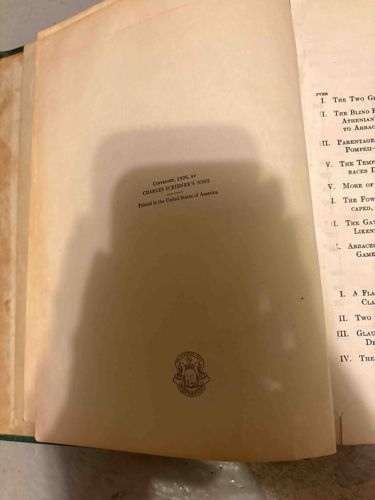
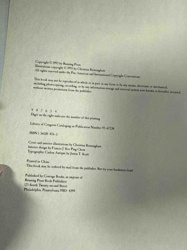
The item is a vintage hardcover book, partially open, revealing its copyright page and a portion of its table of contents or chapter list. The general color of the paper is an aged, light cream or off-white, consistent with paper from the early 20th century. The visible binding edge on the left is a dark green, suggesting a cloth or leather cover. The copyright information is clearly printed on the left-hand page, stating 'Copyright, 1905, BY CHARLES SCREDNER'S SONS Printed in the United States of America.' Below this text, centered on the page, is an embossed or printed publisher's emblem, featuring what appears to be a classical motif, possibly a shield or crest with figures, though the details are somewhat blurred. The page shows minor discoloration and age-related toning, particularly along the edges and near the spine, which is typical for a book of this age. There are no major tears or rips immediately visible on this page. The right-hand page displays a table of contents or chapter headings, starting with roman numerals and titles such as 'I. THE TWO G...', 'II. PARENTAGE...', 'V. THE TEMP...', 'L. THE FOW...' and then further down 'I. A FLA...', 'II. Two...', 'III. GLAU...'. The font used for the text is a classic serif type, standard for books of this period. The overall condition suggests a well-preserved antique or vintage book. The craftsmanship points to a quality production typical of major publishers like Charles Scribner's Sons during that era.
AI Appraisal Report
I have examined the provided image of this vintage hardcover book, copyright 1905 by Charles Scribner's Sons. The overall condition appears to be well-preserved for its age, with typical discoloration and age-related toning, particularly along the edges and near the spine. The dark green binding suggests a cloth or leather cover, indicative of quality production from that era. The visible publisher’s emblem and classic serif font further support its authenticity as a period piece by a reputable publisher.
Based on the visual evidence, the book's condition is 'good' to 'very good' for its age, showing routine wear but no immediately visible major damage like tears or severe foxing on the visible pages. However, the title of the book is not visible, which significantly impacts its market value. The market for general vintage hardcover books from this period, especially common titles, is broad but not particularly high-value unless it is a first edition of a significant work, a rare book, or one with authorial importance or unique binding.
Without knowing the specific title and author, assessing rarity or high demand is impossible. Most books from major publishers like Scribner's Sons were printed in significant quantities. Factors that would significantly increase value include being a first edition of a seminal work (e.g., Fitzgerald, Hemingway, etc., though 1905 predates their major works), authorial signature, or exceptionally rare content. Given the general nature of the visible information, this appears to be a standard vintage publication.
My appraisal is limited by the fact that I cannot see the title, author, or the full extent of the book's condition (e.g., condition of the cover, spine, all pages, presence of dust jacket, if any). An in-person examination would be crucial to identify the exact title, assess the complete physical condition, and verify any unique attributes that might enhance its value. Provenance documentation would also confirm its history. However, based solely on what's visible, this book falls into a common category of vintage hardcovers without extraordinary indicators of high value.