AI estimate as of August 11, 2025 · verify with a professional before acting
AI-Generated · Verify before acting
Everything on this page is generated by AI for informational purposes only. AI can make mistakes — the AI may misidentify items or misattribute them (artist, maker, brand, designer, origin, era). This is not an official valuation and should not be used for insurance, sale, tax, estate, legal, or lending purposes — or any decision requiring a certified appraisal. It is not an authoritative claim about any person, brand, or rights holder — do not share or rely on it as a factual statement about a third party. Always consult qualified professionals before making financial decisions.
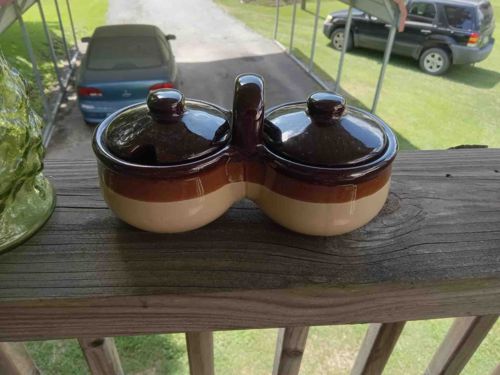
This item is a ceramic double crock, salt and pepper cellar, or condiment server, designed with two connected, rounded compartments and individual lids. The material appears to be glazed stoneware or pottery, giving it a sturdy and functional aesthetic. Each compartment features a two-tone color scheme: the lower portion is unglazed or a matte light tan/beige color, while the upper band and the domed lids are finished with a glossy, dark brown glaze. A handle or divider, also dark brown and glossy, connects the two compartments at the top center, facilitating easy transport or serving. The lids sit snugly within the rims of the crocks, showcasing well-formed pottery and precise fitting. There are no obvious chips, cracks, or significant visible condition issues such as severe wear or repairs; the glaze appears to be intact and shiny. The overall construction suggests good craftsmanship, with smooth curves and a uniform finish. Without clearer views of the underside, specific manufacturing details like maker's marks or stamps are indiscernible. Based on its style and common use of such color schemes, it likely belongs to the mid-20th century, possibly from the 1960s or 1970s, reminiscent of American country or rustic kitchenware. Its functional design and durable material indicate it was intended for regular use, possibly for serving sugar and creamer, salt and pepper, or other condiments.
AI Appraisal Report
Upon examining the provided image of this Ceramic Double Crock/Condiment Server, I assess its condition as excellent. The glazes appear intact with good sheen, and there are no visible chips, cracks, or significant wear. The fit of the lids and the overall craftsmanship suggest a well-preserved piece. Authenticity, based on visual cues, points to a mid-20th-century production, likely 1960s or 1970s, aligning with common American rustic kitchenware styles of that period. The two-tone design with a glossy dark brown and matte light tan is characteristic of stoneware trends from that era.
In terms of market conditions, vintage kitchenware and tableware, especially functional yet decorative pieces, generally maintain a steady demand. While not exceedingly rare, items in such pristine condition are less common. Comparables in the market, often found on online marketplaces or at vintage shops, include similar ceramic condiment servers or double crocks from the mid-century period. Pieces from known potteries or with distinctive design elements might fetch higher prices, but this piece's aesthetic aligns with a broad, appealing style.
Factors impacting value include its excellent condition, functional appeal, and vintage charm. The lack of visible damage significantly enhances its collectibility. While demand is consistent for such utility items, they rarely command exceptionally high prices unless tied to a famous designer or manufacturer, which is not evident here. Its primary appeal lies in its decorative utility for a country or rustic-themed kitchen.
It is crucial to note the limitations of authenticity verification from images alone. A physical examination would allow me to inspect the underside for maker's marks or stamps, which are vital for pinpointing origins and potentially identifying a specific manufacturer that could increase value. I would also perform a tactile inspection for surface irregularities, hidden repairs, or variations in glaze that are not apparent in photographs. Furthermore, scientific testing (e.g., thermoluminescence dating) would be necessary for definitive age verification, although for an item of this type and value, it would likely be cost-prohibitive and unnecessary. Provenance documentation, such as original purchase receipts or family history, would also strengthen its authenticity and could add to its perceived value.