AI estimate as of July 17, 2025 · verify with a professional before acting
AI-Generated · Verify before acting
Everything on this page is generated by AI for informational purposes only. AI can make mistakes — the AI may misidentify items or misattribute them (artist, maker, brand, designer, origin, era). This is not an official valuation and should not be used for insurance, sale, tax, estate, legal, or lending purposes — or any decision requiring a certified appraisal. It is not an authoritative claim about any person, brand, or rights holder — do not share or rely on it as a factual statement about a third party. Always consult qualified professionals before making financial decisions.
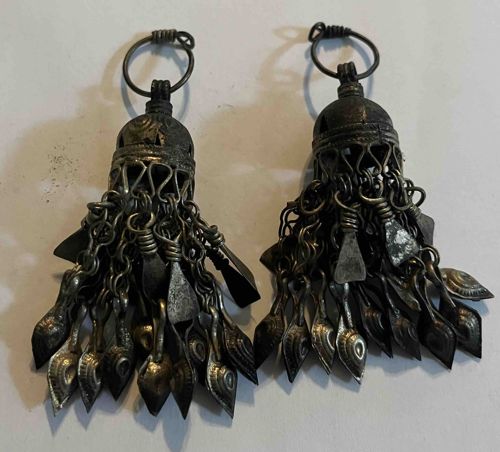
This pair of ethnic or tribal silver-toned ornaments, possibly earrings or pendants, demonstrates intricate craftsmanship and a significant patina. Each piece comprises a bell-shaped top element from which multiple chains and decorative elements dangle, resembling a tassel or chandelier design. The top bell section appears to be hollow and features cut-out or openwork patterns, possibly indicating filigree or chased detailing, although the exact technique is obscured by wear and oxidation. Above the bell, a wire-wrapped bail provides a loop for attachment. The dangling elements are varied, including numerous small chains, wire coils, and various shaped metal pieces. Many of these pieces are flat, elongated, leaf-shaped, or triangular, some showing subtle embossed or incised patterns. The overall material appears to be a base metal with a dark, aged patina suggesting silver or a silver alloy that has tarnished significantly over time. The construction shows signs of handmade work, with irregularities in the uniformity of the dangling components and the wire wrapping. There are visible signs of wear, including darkening of the metal, slight bending or distortion of some hanging elements, and potential surface abrasions consistent with age and use. The artisanal nature suggests an origin from traditional jewelry-making cultures, possibly North Africa, the Middle East, or Central Asia. The robust, albeit aged, construction indicates durability. No clear maker's marks or signatures are discernible from the images, making precise attribution challenging. The substantial accumulation of grime and tarnish points to considerable age, likely late 19th to mid-20th century.
AI Appraisal Report
Based on my visual examination of the provided image, this pair of ethnic/tribal silver-toned tassel ornaments appears to be authentic, handcrafted pieces consistent with traditional jewelry from North Africa, the Middle East, or Central Asia. The significant patina, detailed yet irregular craftsmanship, and signs of wear strongly suggest age and genuine artisanal origin. I assess their condition as good, considering their likely age; the tarnish and minor distortions are consistent with use and time rather than severe damage.
Market conditions for ethnic tribal jewelry have a niche but consistent demand. Comparables for similar pieces, often listed as Turkmen, Berber, or Bedouin tribal jewelry, can range widely based on material purity (sterling silver vs. high-grade alloy), exact origin, and craftsmanship. These pieces, if high-content silver, typically command higher prices. Their rarity lies more in their unique handmade character than in being one-of-a-kind museum pieces, as many similar designs exist within these traditions.
Factors significantly impacting value include the actual metal content (silver purity), which cannot be determined visually. If silver, their value is higher. The strong aesthetic appeal and historical context enhance their desirability among collectors of ethnographic jewelry.
Limitations in authenticity verification from images alone are significant. I cannot definitively confirm metal composition (silver vs. base metal), internal structure of the bell, or precise manufacturing techniques. Full authentication would require in-person examination to assess weight, test metal content (e.g., acid test or XRF analysis), inspect construction details under magnification, and potentially remove some grime to reveal hidden marks or details. Provenance documentation, if available, would also be invaluable for confirming origin and age.