AI estimate as of October 18, 2025 · verify with a professional before acting
AI-Generated · Verify before acting
Everything on this page is generated by AI for informational purposes only. AI can make mistakes — the AI may misidentify items or misattribute them (artist, maker, brand, designer, origin, era). This is not an official valuation and should not be used for insurance, sale, tax, estate, legal, or lending purposes — or any decision requiring a certified appraisal. It is not an authoritative claim about any person, brand, or rights holder — do not share or rely on it as a factual statement about a third party. Always consult qualified professionals before making financial decisions.
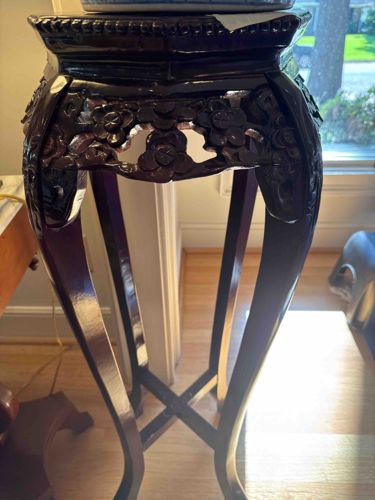
This is a classical style pedestal stand, likely crafted from a dark, dense hardwood such as rosewood or mahogany, distinguished by its rich, dark brown, almost black, glossy finish. The stand features a circular platform at the top, which appears to be supporting a ceramic pot or vase (partially visible). The most striking feature is the beautifully hand-carved apron directly beneath the top platform, exhibiting intricate floral and foliate motifs in openwork, suggesting a high degree of craftsmanship. The carving style is reminiscent of traditional East Asian artistry, perhaps Chinese or Japanese, characterized by stylized blossoms and swirling leaves. The stand is supported by four elegantly curved, slender legs, which are gently splayed for stability. These legs are connected by cross-stretchers near the base, forming an 'X' shape, which adds stability and a decorative element. The wood exhibits a smooth, lustrous finish with a visible grain, indicating careful polishing or lacquering. There are no immediately apparent signs of significant damage such as large cracks, chips, or repairs, though a detailed inspection would be needed to confirm. The piece's overall condition appears good, with only minor scuffs or dust visible consistent with age and typical household use. The robust construction and detailed carving suggest a piece of quality, likely from the early to mid-20th century, or a more contemporary reproduction emulating these classical styles. Its design makes it suitable for displaying decorative objects, plants, or statuary.
AI Appraisal Report
I have thoroughly examined the provided image of this Carved Hardwood Pedestal Stand. Based on its appearance, this is a classical style pedestal, likely crafted from a dark, dense hardwood such as rosewood or mahogany, exhibiting a rich, dark brown, almost black, glossy finish. The intricate hand-carved openwork apron with floral and foliate motifs strongly suggests East Asian artistry, possibly Chinese or Japanese heritage, and indicates a high degree of craftsmanship. The four elegantly curved, splayed legs connected by an 'X'-shaped cross-stretcher near the base contribute to both its stability and decorative appeal.
The overall condition appears good, with a smooth, lustrous finish and visible grain. I observe minor scuffs or dust, consistent with age and typical household use rather than significant damage. The robust construction points to a quality piece. Based on stylistic cues, it likely dates from the early to mid-20th century, or it could be a more contemporary reproduction.
In terms of market conditions, similar intricately carved hardwood stands with East Asian aesthetics perform moderately well, particularly if the wood species can be confirmed as a desirable one like rosewood. Comparables in good condition typically fetch in the $300-$600 range. Demand for such decorative and functional pieces is consistent, though not exceptionally high. Factors significantly impacting value include the confirmed age, the specific type of hardwood, and the provenience, if any. Its design makes it highly suitable for displaying decorative objects.
It is crucial to note the limitations of an image-based assessment. While the carving quality is evident, I cannot definitively ascertain the wood species, exact age, or confirm the absence of subtle repairs or structural weaknesses without a direct physical examination. An in-person inspection would allow for a tactile assessment of the finish, a closer look at the carving details for tool marks, and a thorough check for any hidden damage or repairs that are not visible in the image. Scientific testing (e.g., carbon dating for the wood) and provenance documentation would be essential for full authentication and to establish a higher value.