AI estimate as of October 5, 2025 · verify with a professional before acting
AI-Generated · Verify before acting
Everything on this page is generated by AI for informational purposes only. AI can make mistakes — the AI may misidentify items or misattribute them (artist, maker, brand, designer, origin, era). This is not an official valuation and should not be used for insurance, sale, tax, estate, legal, or lending purposes — or any decision requiring a certified appraisal. It is not an authoritative claim about any person, brand, or rights holder — do not share or rely on it as a factual statement about a third party. Always consult qualified professionals before making financial decisions.
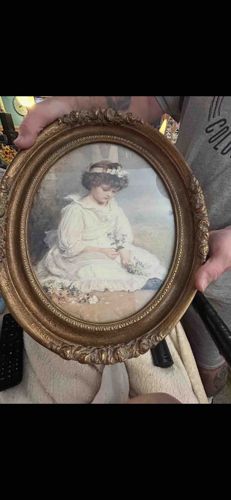
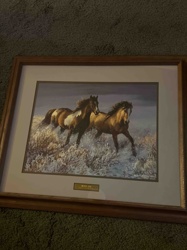
This item is an oval-shaped print or lithograph, likely a portrait, depicting a young girl in a pastoral setting, encased within a decorative gilt frame. The print features a young girl with an introspective or demure expression, seated amidst foliage, wearing a light-colored, possibly white or cream, long-sleeved dress with a ruffled collar and gathering at the cuffs. Her hair is short and curly, styled with a floral wreath or band across her forehead. She is holding small bouquets of flowers in her lap and hands, and additional small flowers are scattered around her on the ground. The background appears to be a softly blurred landscape, suggestive of an outdoor scene. The colors are muted and soft, typical of late 19th or early 20th-century aesthetic prints. The frame is oval, crafted from wood or composition material, and finished with a rich gold gilt. It features an ornate, deeply molded design, predominantly a scrolled or floral motif, with significant three-dimensional relief, especially visible at the top, bottom, and sides. The gilding shows some signs of age, including minor darkening and possibly some loss of luster in areas, though it largely retains its decorative appeal. There are no immediately obvious significant condition issues like cracks or major chipping on the frame, nor prominent water damage or fading on the print, although a closer inspection would be required to confirm this. The overall aesthetic points to a Victorian or Edwardian era style, emphasizing sentimentality and romanticism. The craftsmanship of the frame is substantial, indicating a commercial product meant to evoke luxury. This piece likely served as decorative wall art in a parlor or drawing-room.
AI Appraisal Report
Based on my visual examination of the provided image, this Victorian-style oval portrait print in a gilt frame presents as a decorative piece from the late 19th or early 20th century. The print, likely a chromolithograph or similar reproduction, depicts a sentimental pastoral scene with a young girl, typical of the era's aesthetic. The colors appear soft and muted, consistent with period prints, and I observe no overt signs of significant fading or water damage from the image. The ornate gilt frame, with its substantial scrolled and floral relief, appears to be in good overall condition for its age, showing expected darkening and minor loss of luster in the gilding, which contributes to its antique charm rather than detracting significantly from its value. No obvious cracks or major chips are visible in the frame's composition from this perspective.
Market conditions for such decorative Victorian-era prints, unless by a particularly renowned artist or of exceptional rarity, are generally modest. Comparables often point to prices in the lower hundreds, with the frame sometimes contributing more to the value than the print itself. Demand is steady among collectors of period decor, but not particularly high, limiting rapid value appreciation. While appealing, this item is not rare; similar sentimental prints were mass-produced. Factors impacting value include the decorative quality of the frame, the subject matter's appeal, and its overall condition. The lack of a specific artist's signature or print number limits its collectibility beyond its decorative merit.
It is crucial to note the limitations of authenticity verification from images alone. Without physical inspection, I cannot definitively assess the print's medium (e.g., lithograph, photogravure, or another reproduction method), the extent of any subtle fading, foxing, or environmental damage to the print, or the structural integrity and material composition of the frame. An in-person examination would reveal the presence of any repairs, the true state of discoloration, and allow for a closer inspection of manufacturing marks. Provenance documentation could also shed light on its history and origin, potentially adding to its value. Scientific testing is not typically applied to items of this type unless there's a strong reason to suspect a misattribution to a known artist or a rare print technique, which is not suggested by the visual evidence here.