AI Appraisal Estimate

AI-generated estimates · not official valuations

From the user

What was submitted

Photo and notes provided by the user — not generated by AI

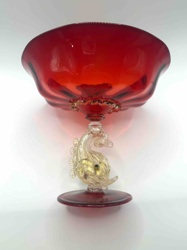
Submitted item photo
Submitted photo · May 19, 2026

User's notes

Art nouveau bowl

AI analysis below

AI appraisal

AI analysis & estimate

AI-Generated · Verify before acting

Everything below is generated by AI for informational purposes only. AI can make mistakes — the AI may misidentify items or misattribute them (artist, maker, brand, designer, origin, era). This is not an official valuation and should not be used for insurance, sale, tax, estate, legal, or lending purposes — or any decision requiring a certified appraisal. It is not an authoritative claim about any person, brand, or rights holder — do not share or rely on it as a factual statement about a third party. Always consult qualified professionals before making financial decisions.

Note

This analysis also relies on unverified notes provided by the user, which may be incomplete or inaccurate and could affect the result.

Read the full disclaimer

AI Identification

·Not independently authenticated·Verify before acting

Art Nouveau Legras-style Enameled Glass Bowl with Pewter Overlay

Antique Art Glass

AI Estimated Value

·Not an official valuation·Verify before acting

$450 - $650

As of May 19, 2026

AI Item Analysis

·AI can make mistakes·Verify before acting
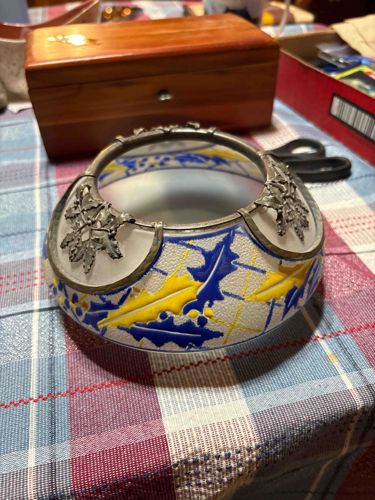
This is a distinctive Art Nouveau period art glass bowl, likely of French origin and reminiscent of the work of François-Théodore Legras. The bowl features a globular, squat body made of thick, frosted 'ice glass' (or 'verre givré') which gives the substrate a textured, pebbled appearance. It is elaborately decorated with hand-painted enamel botanical motifs, specifically stylized holly leaves in bold cobalt blue and vibrant yolk yellow, set against an abstract gold-toned lattice pattern. A significant feature of this piece is the ornate metal rim, likely made of pewter or a similar white-metal alloy, which incorporates a 'monture' or mount. This mounting features four decorative cast leaf-and-vine appliques that drape over the side of the glass, characteristic of the transition between Art Nouveau and early Art Deco design. The glass itself appears to be in good condition without visible cracks, though there is minor surface wear consistent with an age of approximately 100-120 years. The metal overlay exhibits a natural age patina, showing darkening in the recessed areas of the casting. The interior reveals the white base of the glass, suggesting it may be cased or heavily enameled. This combination of glass and metalwork was highly popular in European decorative arts between 1895 and 1915.
AI Appraisal Report

·AI can make mistakes·Verify before acting
Based on my visual examination of this Art Nouveau art glass bowl, I have determined it to be a fine example of French commercial art glass from the turn of the 20th century. The piece strongly correlates with the output of the Legras & Cie works at Saint-Denis or potentially the Mont Joye line. The 'verre givré' (frosted ice) ground coupled with high-relief enamel 'houx' (holly) motifs reflects the popular naturalist aesthetic of circa 1900. The pewter 'monture' (mount) is a desirable feature that elevates the piece from standard glassware to a decorative centerpiece. The condition appears remarkably well-preserved for its age. I note no significant 'flea bites' to the rim or loss of the thick enamel. The patina on the pewter mount is consistent with age and should not be polished, as original oxidation is preferred by collectors. While Legras pieces were frequently unsigned, the quality of the enamel execution suggests an authentic period production rather than a later reproduction. The market for Art Nouveau glass remains stable for examples with mixed-medium elements (glass and metal). Similar unsiged Legras-type bowls typically realize between $400 and $700 at specialized auction houses. Value is driven by the presence of the metalwork and the vibrancy of the blue and yellow pigments. However, a definitive attribution to Legras or Mont Joye would require a physical search for a faint 'acid-etched' signature or a match in a period trade catalog. Limitations of this photo-based appraisal include the inability to check for internal strain cracks or to verify the alloy composition of the rim. A full authentication would require hands-on inspection of the base for wear patterns and provenance documentation.

Get your items appraised

Instant estimates of your treasures with AI-powered appraisals

Browse More Appraisals