AI estimate as of November 15, 2025 · verify with a professional before acting
AI-Generated · Verify before acting
Everything on this page is generated by AI for informational purposes only. AI can make mistakes — the AI may misidentify items or misattribute them (artist, maker, brand, designer, origin, era). This is not an official valuation and should not be used for insurance, sale, tax, estate, legal, or lending purposes — or any decision requiring a certified appraisal. It is not an authoritative claim about any person, brand, or rights holder — do not share or rely on it as a factual statement about a third party. Always consult qualified professionals before making financial decisions.
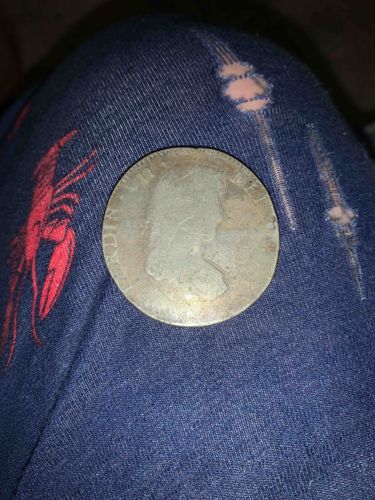
The item is a circular metal coin, appearing to be made of a silver or silver-colored alloy, with a diameter that suggests it is a relatively large denomination or type of currency. Its surface shows significant wear and tarnish, indicating considerable age and circulation. The primary feature visible is the obverse side, which prominently displays a profile bust of a person, likely a monarch or dignitary, facing to the left from the viewer's perspective. The head is partially obscured by wear, but outlines of what appears to be a wig or styled hair are discernible, characteristic of European portraiture from the 17th or 18th centuries. Around the edge of the coin, faded Latin or a similar script is faintly visible, with letters such as 'RDIN' and 'B' being somewhat legible, suggesting a legend identifying the ruler or originating country. The overall condition is poor, with significant loss of detail due to age, environmental exposure, and handling. There are no clear mint marks or dates immediately visible due to the degraded state of the coin's surface. The metal exhibits a dull, oxidized patina with some darker spots, consistent with aged silver or a similar base metal. The rim appears to be intact but also shows wear. The lack of distinct features makes precise identification challenging without further examination of the reverse side or clearer images.
AI Appraisal Report
I have examined the provided image of a circular metal coin, appearing to be silver or a silver-colored alloy, which I assess to be a European coin potentially from the 17th or 18th century based on the visible profile bust and stylistic elements. The coin is in poor condition, exhibiting significant wear, tarnish, and a dull, oxidized patina. The obverse shows a profile bust, likely a monarch, with what appears to be a wig. Faint remnants of a legend, possibly Latin, are visible but largely illegible. The lack of clear mint marks, dates, or distinct features severely hinders precise identification.
Authenticity, based solely on this image, is difficult to definitively confirm. The wear and patina are consistent with an aged coin, but without physical examination, I cannot rule out modern reproductions or altered pieces. A thorough in-person examination would allow for closer inspection of metal composition, weight, and edge details. Provenance documentation, if available, would significantly aid in authentication. Elemental analysis could confirm the metal composition.
Due to its poor condition and lack of identifiable features, the rarity and demand for this specific coin are considerably diminished. While 17th-18th century European silver coins can be valuable, this piece, in its current state, would appeal primarily to collectors of extremely worn or unidentified specimens, or those interested in historical 'junk silver.' Comparable sales for unidentified, heavily worn silver coins of this era typically fall into a lower price bracket. The value reflects its intrinsic metal content and its potential, albeit limited, as a historical artifact.
Factors significantly impacting value upwards would include definitive identification of the ruler/state, a clear date, and improved condition. Downwards, counterfeiting or identification as a common, low-value coin in poor condition would further reduce its value.