AI estimate as of August 22, 2025 · verify with a professional before acting
AI-Generated · Verify before acting
Everything on this page is generated by AI for informational purposes only. AI can make mistakes — the AI may misidentify items or misattribute them (artist, maker, brand, designer, origin, era). This is not an official valuation and should not be used for insurance, sale, tax, estate, legal, or lending purposes — or any decision requiring a certified appraisal. It is not an authoritative claim about any person, brand, or rights holder — do not share or rely on it as a factual statement about a third party. Always consult qualified professionals before making financial decisions.
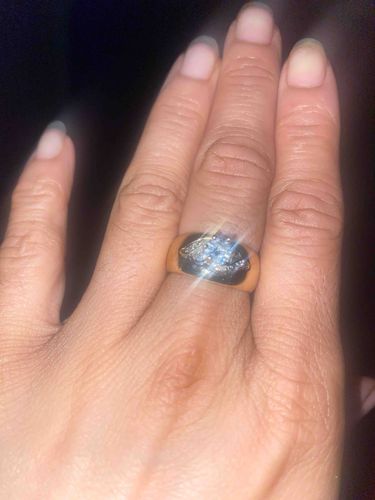
The item is a wide band ring, likely crafted from yellow gold given its warm, lustrous gleam, though it could also be a gold-plated base metal. The band appears to be fairly thick and substantial, suggesting a bold design or a comfort fit. The most prominent feature is the central setting, which is either white gold or platinum, contrasting sharply with the yellow tone of the band. This central setting is circular or slightly oval and appears to be 'domed' or raised. It is adorned with multiple small, round, brilliant-cut stones, which are likely diamonds or high-quality cubic zirconia, set closely together to create a pavé or cluster effect. One larger, central stone, which appears to be a light blue color, is securely set, possibly as a sapphire, aquamarine, or a similarly colored imitation. The stones exhibit significant sparkle, indicating good faceting and clarity, though the specific quality cannot be determined from the image. The ring shows some surface reflections and highlights, typical of polished metal. There are no clearly visible signs of significant wear, damage, or repairs on the portions of the ring that are visible. The overall impression is one of a well-made, potentially contemporary piece, designed for everyday wear or as a statement ring. Without clearer images or hallmarks, the precise age or maker is difficult to ascertain, but the style suggests a more modern aesthetic rather than an antique piece.
AI Appraisal Report
I have examined the provided image of this two-tone gold ring with a diamond-set cluster and central blue stone. Based on visual assessment, the ring appears to be in very good condition with no visible signs of significant wear, damage, or repairs. The two-tone design, featuring a yellow gold-toned band and a white metal central setting, suggests a contemporary aesthetic. The prominent central cluster, set with multiple small, round brilliant-cut stones surrounding a larger blue stone, creates a significant visual impact.
Limitations of visual identification from an image are significant. While the smaller stones exhibit good sparkle, suggesting diamonds or high-quality cubic zirconia, definitive identification is impossible without direct examination using a jeweler's loupe, diamond tester, and refractometer. Similarly, the blue central stone could be a natural sapphire, aquamarine, or a simulant like cubic zirconia or treated glass. Its exact color saturation and clarity, crucial for valuation, cannot be precisely determined. The metal appears to be gold, but whether it is solid gold, gold-plated, or gold-filled cannot be confirmed without testing for hallmarks or acid testing.
Market conditions for two-tone rings with diamond clusters and colored gemstones are generally stable, driven by aesthetic appeal and versatility. If the stones are genuine diamonds and a natural sapphire, the demand is consistent. However, if they are simulants, the demand is significantly lower. Rarity is not a significant factor unless the piece is from a renowned maker or features exceptionally rare stones; without hallmarks, this cannot be determined.
Factors significantly impacting value include the authenticity, carat weight, cut, clarity, and color of the diamonds, the type, origin, and quality of the blue stone, and the purity and weight of the gold. Without physical inspection, provenance documentation, or scientific testing (such as XRF for metal composition, spectroscopic analysis for gemstones), a definitive appraisal is not possible. For full authentication and accurate valuation, a hands-on examination by a certified gemologist is essential.