AI estimate as of August 6, 2025 · verify with a professional before acting
AI-Generated · Verify before acting
Everything on this page is generated by AI for informational purposes only. AI can make mistakes — the AI may misidentify items or misattribute them (artist, maker, brand, designer, origin, era). This is not an official valuation and should not be used for insurance, sale, tax, estate, legal, or lending purposes — or any decision requiring a certified appraisal. It is not an authoritative claim about any person, brand, or rights holder — do not share or rely on it as a factual statement about a third party. Always consult qualified professionals before making financial decisions.
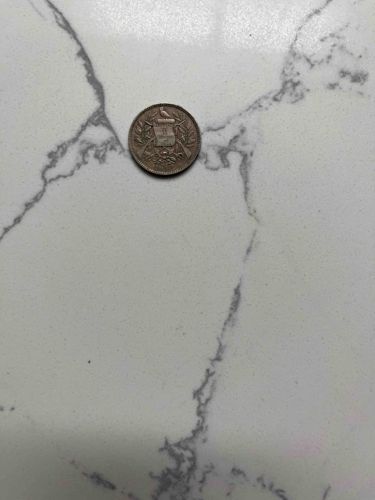
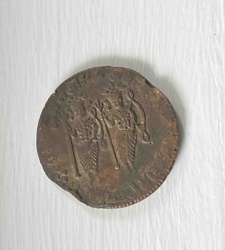
The item is a circular metal coin, appearing to be made of a silver-colored alloy, possibly silver or a silver-plated base metal given its dull luster and the presence of what looks like toning or patina. The coin exhibits an obverse design featuring a central shield-like emblem with a bird perched atop it. Flanking the shield on either side are what appear to be branches or wreaths, likely laurel or olive, with a rifle or musket-like object prominently positioned on the right and an unidentified long object on the left, possibly a sword or another weapon given the context of a national emblem. Below the shield, there is a ribbon or banner. The design elements are somewhat worn, indicating circulation or age, but the overall form is still discernible. The edges of the design show some loss of sharpness, and there are visible surface scratches and minor abrasions consistent with prolonged handling and environmental exposure. The coin's color is a muted gray-silver, with darker areas suggesting tarnish or oxidation. There are no immediately visible dates or denominations on this side, which would typically be present on a coin; these might be on the reverse, or they are too worn to be seen in the provided image. The rim appears slightly raised, characteristic of coinage, though some flattening of this rim is evident in areas. The craftsmanship, while appearing somewhat crude by modern standards, is consistent with older minting processes, highlighting an observable level of detail in the heraldic elements.
AI Appraisal Report
Upon examining the provided image of what appears to be a Central American coin, likely from Guatemala, I note several key factors influencing its appraisal. The coin exhibits significant wear, particularly in the central emblem, indicating substantial circulation. This wear, coupled with visible surface scratches and toning, suggests a condition I would describe as Fine (F) to Very Fine (VF) at best, far from uncirculated. The metal appears to be a silver-colored alloy, though without physical examination, I cannot confirm its silver content or purity; it could be silver, cupronickel, or a similar alloy. The "crude" appearance is consistent with minting processes of the era. Authenticity, based solely on this image, seems plausible as there are no obvious visual indicators of a modern forgery. However, crucial details such as date, denomination, and mint marks are absent or too worn to discern, significantly limiting a precise identification and valuation.
In terms of market conditions, similar worn examples of early Central American coinage, particularly from Guatemala with the Quetzal emblem, fetch modest prices unless they are rare dates or high grades. Without a definitive date, rarity cannot be assessed. Demand for such items exists among specialized collectors of Latin American numismatics, but broad market appeal for a heavily circulated, unidentified coin with a potentially common design is limited. Factors significantly impacting value are the specific date, precise denomination, confirmed metal composition (especially if high-purity silver), and the certainty of its origin.
For full authentication and a more precise appraisal, a direct in-hand examination is essential. This would allow for a detailed analysis of the edge, weight, diameter, specific gravity (to determine metal composition), and a closer inspection under magnification to locate any faint dates or mint marks. Provenance documentation, if available, would also be invaluable. Without these, the appraisal remains speculative.