These notes were written by the person who submitted this item. Appraiser.AI has not verified them, and the AI's identification and estimate may rely on them.
AI Estimated Value
Not an official valuation
$60-100
AI estimate as of November 20, 2025 · verify with a professional before acting
AI-Generated · Verify before acting
Everything on this page is generated by AI for informational purposes only. AI can make mistakes — the AI may misidentify items or misattribute them (artist, maker, brand, designer, origin, era). This is not an official valuation and should not be used for insurance, sale, tax, estate, legal, or lending purposes — or any decision requiring a certified appraisal. It is not an authoritative claim about any person, brand, or rights holder — do not share or rely on it as a factual statement about a third party. Always consult qualified professionals before making financial decisions.
This analysis also relies on unverified notes provided by the user, which may be incomplete or inaccurate and could affect the result.
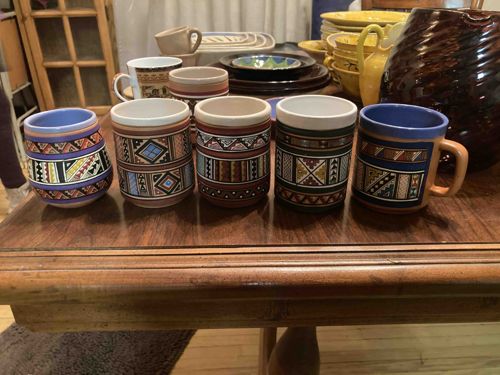
This is a set of five ceramic cups, likely originating from or inspired by Peruvian folk art traditions, given the 'Peruvian cups' context provided. The cups exhibit a rustic, artisanal quality, suggesting they are handcrafted rather than mass-produced. Each cup is made from a buff-colored earthenware or terracotta base, left unglazed on the exterior lower portions and interior, giving them a matte, earthy texture. The exteriors are extensively decorated with intricate geometric patterns in a vibrant, multi-colored palette. Colors used include blues (light and dark), purples, reds, oranges, yellows, and white, applied over dark brown or black outlines. The patterns are consistent with traditional Andean textile designs, featuring repeating motifs of diamonds, triangles, zigzags, and stepped patterns, often arranged in horizontal bands. Four of the cups are handleless beakers, while one is a mug with a visible handle, molded from the same ceramic material and integrated into the design. The rim of each cup is glazed in a solid color; one has a light blue rim, two have white rims, and two have dark brown/red rims. The cup with the handle also features a light blue interior glaze. The size appears to be standard for drinking cups, likely 4-6 inches in height. Condition appears good, with no obvious chips, cracks, or significant wear visible from the provided images, though a closer inspection would be needed to detect minor flaws or crazing in the glaze. The craftsmanship suggests a folk art or souvenir item, valuing decorative appeal over fine porcelain perfection. Estimated age is likely 20th to 21st century, as contemporary folk art.
AI Appraisal Report
Upon visual examination of the provided images, I assess this set of five ceramic cups, described as 'Peruvian-style,' to be in good overall condition. There are no readily apparent chips, cracks, or significant abrasions. The vibrant, multi-colored geometric patterns, reminiscent of traditional Andean textile designs, are well-preserved. Authenticity as genuinely Peruvian folk art is highly probable given the stylistic elements, but without direct physical inspection or provenance documentation, I cannot definitively confirm their origin or maker. They appear handcrafted, consistent with contemporary folk art or souvenir items from the 20th to 21st century.
The market for such decorative folk art ceramics is moderately active. Comparable items, typically sold in sets, often retail in souvenir shops or online marketplaces. While their decorative appeal is strong, they are not considered rare. The value is primarily driven by their aesthetic quality and the artisanal nature of their creation, rather than by historical significance or renowned artists. Factors impacting value include the good condition, the completeness of the set, and the vibrant, appealing designs. However, the lack of a known artist, historical provenance, or fine art designation limits their upper market potential. Without in-person examination, I cannot confirm the exact type of clay, glaze quality, or detect subtle flaws like crazing. A physical inspection would also allow for a closer look at the craftsmanship details and potential artist signatures, which could slightly alter the valuation.