These notes were written by the person who submitted this item. Appraiser.AI has not verified them, and the AI's identification and estimate may rely on them.
AI Estimated Value
Not an official valuation
$75-150
AI estimate as of July 14, 2025 · verify with a professional before acting
AI-Generated · Verify before acting
Everything on this page is generated by AI for informational purposes only. AI can make mistakes — the AI may misidentify items or misattribute them (artist, maker, brand, designer, origin, era). This is not an official valuation and should not be used for insurance, sale, tax, estate, legal, or lending purposes — or any decision requiring a certified appraisal. It is not an authoritative claim about any person, brand, or rights holder — do not share or rely on it as a factual statement about a third party. Always consult qualified professionals before making financial decisions.
This analysis also relies on unverified notes provided by the user, which may be incomplete or inaccurate and could affect the result.
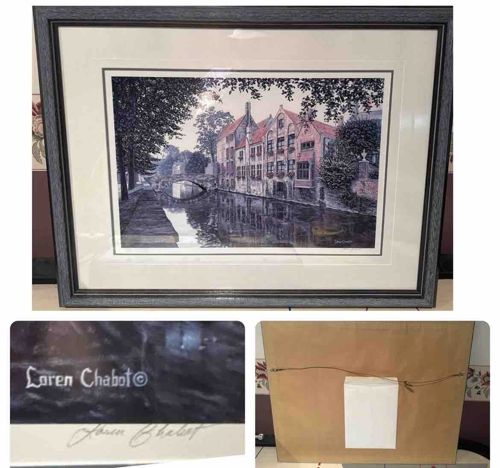
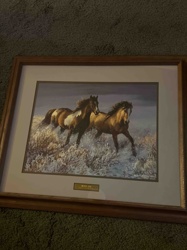
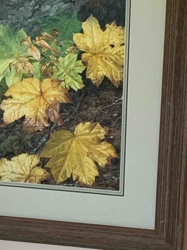
This item is a framed art print depicting a picturesque canal scene, likely in Bruges given the architectural style and user-provided context. The print features a composition with a narrow canal reflecting the surrounding structures and trees. On the left side, a tree-lined walkway runs alongside the canal, leading to a small arched bridge in the mid-ground. On the right, multi-story buildings with distinctive red-tiled roofs and decorative window boxes line the canal's edge, their facades rendered with apparent texture. The color palette appears to be muted, possibly with a dominant use of blues, grays, and subtle reds for the buildings, suggesting it might be a pen and ink or etching technique with watercolor washes, or a digital reproduction thereof. The print is housed under glass within a dark, possibly charcoal gray or black, wooden frame with a visible grain, suggesting a somewhat rustic or classic aesthetic. The framing includes a wide, off-white or cream-colored mat, which provides visual separation between the image and the frame and helps highlight the artwork. The overall dimensions are not provided, but the framing suggests a medium to large size. The back of the frame is covered with brown paper, typical of commercially framed pieces, and includes a wire for hanging. A small white envelope is taped to the back, possibly containing artist information or a certificate. The print is visibly signed 'Loren Chabot' in the lower right corner, with a copyright symbol and additional printed text 'Loren Chabot' visible below that. There are no obvious signs of significant damage to the print itself from the visible areas, though the frame shows some minor wear consistent with handling. The craftsmanship appears to be standard for a mass-produced framed print, with a clean presentation. Without closer inspection, it is difficult to ascertain the exact printing technique (e.g., lithograph, giclée), but the clarity suggests a high-quality reproduction. The style is representational and evokes a traditional European cityscape. Given the artist's name and common print editions, it likely dates from the late 20th or early 21st century.
AI Appraisal Report
I've examined the provided image of the Framed Art Print, 'Bruges Canal Scene' by Loren Chabot. The overall condition appears good; the print itself shows no obvious damage. The frame exhibits minor wear consistent with handling, which is common for a used framed item, but does not significantly detract from its appeal. The quality of the reproduction appears high given the clarity, presented professionally with a tasteful mat and frame.
From a market perspective, Loren Chabot is known for picturesque European cityscapes, often reproduced as prints. While aesthetically pleasing, these are generally mass-produced decorative prints. Demand exists for such pieces, particularly for those seeking evocative European scenes for home or office decor. Rarity is low as these are typically open or large limited editions. Factors impacting value negatively include the non-original print nature and high availability. Positively, the professional framing adds to its presentation and immediate usability.
For authenticity and to determine if this is a signed limited edition or simply a decorative reproduction, an in-person examination would be crucial. I would need to inspect the signature for originality (ink vs. printed), identify the printing technique (e.g., lithograph, giclée, offset), and look for any edition numbers. Provenance documentation, such as a certificate of authenticity or purchase receipts, would also be invaluable. Without this, I must appraise it as a decorative framed print.