AI Appraisal Estimate

AI-generated estimates · not official valuations

From the user

What was submitted

Photo and notes provided by the user — not generated by AI

Submitted item photo
Submitted photo · May 20, 2026

User's notes

No additional notes provided.

AI analysis below

AI appraisal

AI analysis & estimate

AI-Generated · Verify before acting

Everything below is generated by AI for informational purposes only. AI can make mistakes — the AI may misidentify items or misattribute them (artist, maker, brand, designer, origin, era). This is not an official valuation and should not be used for insurance, sale, tax, estate, legal, or lending purposes — or any decision requiring a certified appraisal. It is not an authoritative claim about any person, brand, or rights holder — do not share or rely on it as a factual statement about a third party. Always consult qualified professionals before making financial decisions.

Read the full disclaimer

AI Identification

·Not independently authenticated·Verify before acting

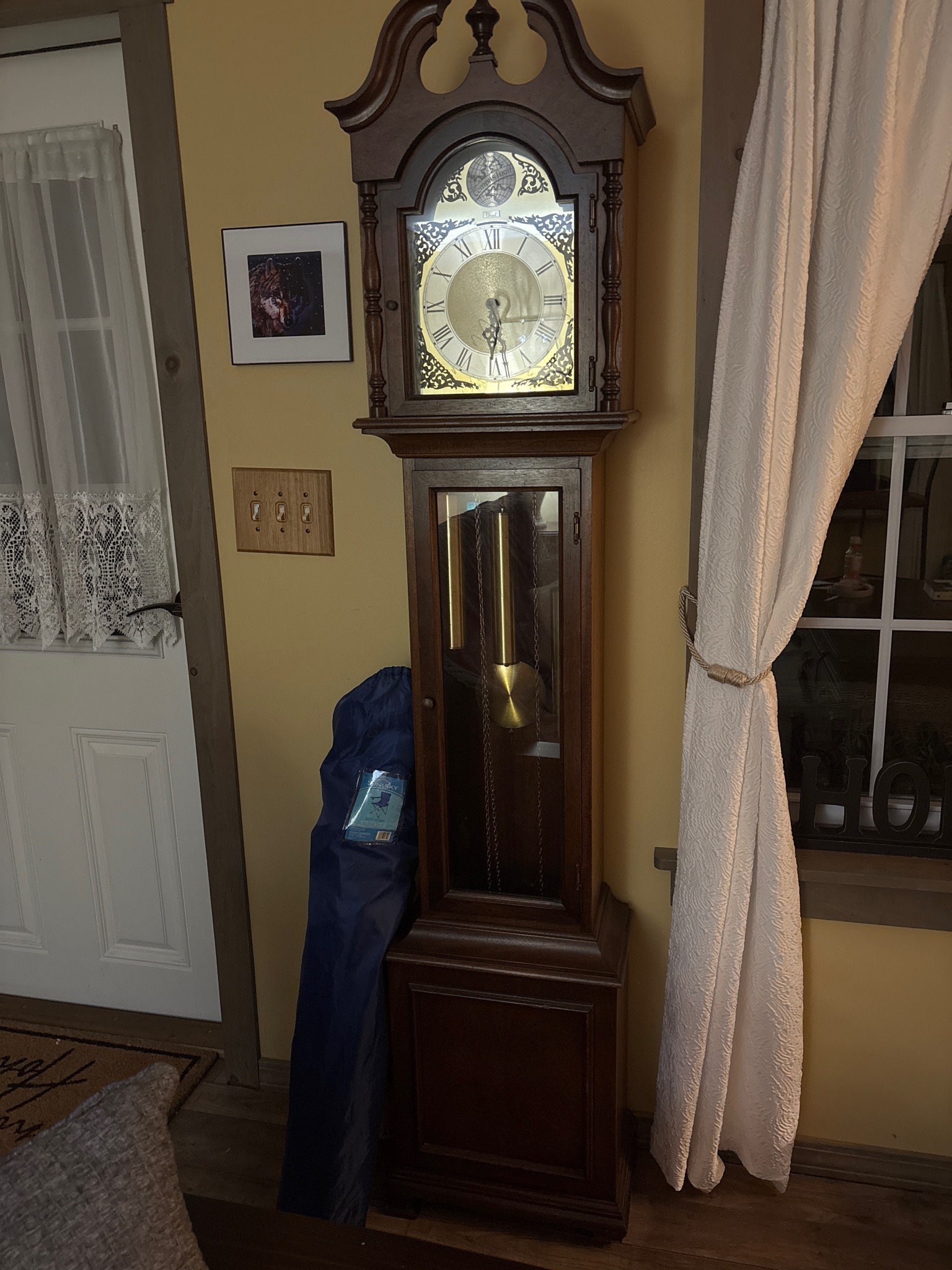
Floor-standing longcase clock, likely late 20th-century style

Clocks

AI Estimated Value

·Not an official valuation·Verify before acting

$600 - $1,200

As of May 20, 2026

AI Item Analysis

·AI can make mistakes·Verify before acting
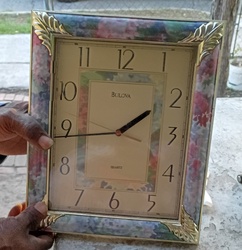
This item is a floor-standing longcase clock (frequently termed a 'grandfather clock') featuring a dark-stained wood cabinet with a traditional pediment crown. The bonnet includes a swan-neck pediment with a central finial or pedestal, supported by slender reeded columns flanking the dial door. The arched dial plate appears to be made of polished metal, bearing Roman numerals on a silver-toned chapter ring. Within the arch, a revolving moon phase disk or globe is visible, inscribed with 'Tempus Fugit,' a common horological motto. The lower case features a long glass access door revealing two visible cylindrical weights and a circular pendulum bob in a brass-toned finish. Stylistically, the construction and finishes are consistent with mass-produced mechanical clocks from the late 20th century. The wood displays a consistent dark mahogany or cherry-style finish with minimal visible wear, though slight dust or surface abrasions may be present. A physical inspection would be required to identify the specific movement manufacturer or cabinet maker, as marks are not clearly legible in the image provided.
AI Appraisal Report

·AI can make mistakes·Verify before acting
Based on my visual analysis of the provided image, I have examined this floor-standing longcase clock, which appears to be a late 20th-century interpretation of traditional horological designs. I can see a dark-stained wood cabinet featuring a swan-neck pediment and a polished metal dial with a 'Tempus Fugit' moon phase disk. While the weights and pendulum suggest a mechanical movement, I cannot verify the manufacturer or the functional state of the internal gears from a photograph. Current market behavior for late 20th-century clocks—often associated with makers like Howard Miller or Ridgeway—shows a range of $600 to $1,200 for examples in good cosmetic condition. This estimate assumes the movement is mechanical and operational; if the clock contains a battery-operated quartz movement or is a non-functioning decorative piece, the value would likely decrease to $150-$300. The provided range is a hypothesis based on the assumption that the wood is a solid hardwood or high-quality veneer and the movement is a genuine mechanical unit. To move beyond this working assumption, a physical inspection is required to check for maker's marks on the movement plates and to verify the wood's composition. Because I cannot provide a definitive identification of the maker without inspecting the back of the dial or the movement, this value should be understood as an estimate for an item of this style. Authentication through provenance documentation or an in-person horological assessment would be necessary to establish a more precise valuation. In the current secondary market, demand for these large-scale traditional pieces has moderated, with value heavily dependent on the complexity of the chime sequences and the overall condition of the finish.

Get your items appraised

Instant estimates of your treasures with AI-powered appraisals

Browse More Appraisals