AI estimate as of September 8, 2025 · verify with a professional before acting
AI-Generated · Verify before acting
Everything on this page is generated by AI for informational purposes only. AI can make mistakes — the AI may misidentify items or misattribute them (artist, maker, brand, designer, origin, era). This is not an official valuation and should not be used for insurance, sale, tax, estate, legal, or lending purposes — or any decision requiring a certified appraisal. It is not an authoritative claim about any person, brand, or rights holder — do not share or rely on it as a factual statement about a third party. Always consult qualified professionals before making financial decisions.
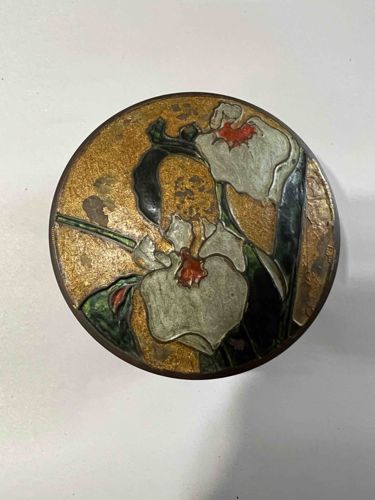
This is a circular, possibly bronze or brass, box lid featuring an intricate cloisonné enamel design. The dominant motif is of irises, depicted with pale, almost off-white petals, highlighted with touches of a reddish-orange hue, likely at their centers. The irises are set against a rich, mottled golden-brown background, which appears to have a textured or hammered finish, contributing to the aged aesthetic. Dark green and black enamels are used to define the stems and leaves of the flowers, providing strong contrast to the lighter petals and the background. The cloisonné technique is evident in the raised metal wires that separate the different colored enamel sections, creating distinct boundaries and a slightly tactile surface. The lid appears to be approximately 2-3 inches in diameter, based on typical box lid sizes. Visible condition issues include areas of wear and minor loss to the golden-brown background enamel, revealing some of the underlying metal, particularly in the upper left quadrant. There is also a general patina consistent with age, suggesting it is a historical piece. The craftsmanship indicates a moderate level of quality, with careful attention to detail in the enamel application and wire work. The stylistic representation of the irises and the use of natural motifs, fluid lines, and rich, organic colors strongly suggest an Art Nouveau period origin, likely late 19th to early 20th century. No discernable maker's marks or signatures are visible from the provided image.
AI Appraisal Report
Based on my visual examination of the provided image, this Art Nouveau cloisonné enamel box lid with an iris design is a charming piece. The style, depicting irises with fluid lines and natural motifs against a mottled golden-brown background, strongly aligns with the Art Nouveau period, likely late 19th to early 20th century. The craftsmanship, particularly the detailed wire work and enamel application, indicates a moderate to good level of quality for its type. The dominant use of pale, almost off-white petals with reddish-orange accents, set against the darker greens and blacks for stems, creates a visually appealing contrast.
Regarding condition, I observe areas of wear and minor enamel loss, particularly in the golden-brown background in the upper left quadrant, revealing the underlying metal. This is a common issue with enameled pieces of this age and contributes to its authentic patina. The general aged appearance is consistent with its likely historical origin.
In terms of market conditions, Art Nouveau decorative arts are consistently sought after, especially pieces displaying characteristic elegance and natural forms. Comparables for unsigned enamel box lids of this quality and period typically range from $200-$500, with condition and artistic merit being key determinants. While there is steady demand for genuine Art Nouveau pieces, this lid, being unsigned and showing some condition issues, falls into the mid-range of desirability for collectors. The absence of a complete box, or any discernable maker's marks, limits its rarity and thus its higher-end valuation.
It is crucial to state that my assessment of authenticity is based solely on visual characteristics from the image. For full authentication, I would require an in-person examination to assess the exact weight, material composition (e.g., specific metal type for the base), and tactile qualities of the enamel and cloisons. Furthermore, provenance documentation would unequivocally confirm its history and origin, and scientific testing, such as XRF analysis, could precisely determine metal and enamel composition. Without these, definitive authentication remains limited to stylistic analysis.