AI Appraisal Estimate

AI-generated estimates · not official valuations

From the user

What was submitted

Photo and notes provided by the user — not generated by AI

Submitted item photo
Submitted photo · June 6, 2026

User's notes

No additional notes provided.

AI analysis below

AI appraisal

AI analysis & estimate

AI-Generated · Verify before acting

Everything below is generated by AI for informational purposes only. AI can make mistakes — the AI may misidentify items or misattribute them (artist, maker, brand, designer, origin, era). This is not an official valuation and should not be used for insurance, sale, tax, estate, legal, or lending purposes — or any decision requiring a certified appraisal. It is not an authoritative claim about any person, brand, or rights holder — do not share or rely on it as a factual statement about a third party. Always consult qualified professionals before making financial decisions.

Read the full disclaimer

AI Identification

·Not independently authenticated·Verify before acting

Mid-Century Fauvist Style Parisian Street Scene Oil Painting

Fine Art - Paintings

AI Estimated Value

·Not an official valuation·Verify before acting

$400 - $650

As of June 6, 2026

AI Item Analysis

·AI can make mistakes·Verify before acting
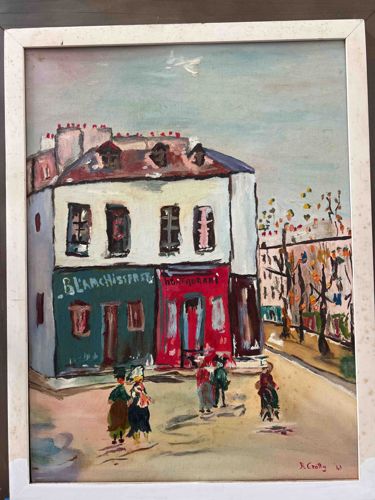
This item is an original oil painting on board or canvas, depicting a bustling Parisian street scene in a Naïve or Fauvist style. The composition features a central white building with a green storefront labeled 'BLANCHISSERIE' (laundry) and a red storefront labeled 'RESTAURANT.' Small, stylized figures in colorful attire occupy the foreground, while a row of trees and another building recede into the distance on the right. The color palette is vibrant, using bold reds, deep greens, and stark whites against a muted sky. The brushwork is expressive and impasto-heavy, particularly in the trees and architectural details. A signature is visible in the lower right corner, appearing to read 'A. Crosby' followed by a date, possibly '61'. The artwork is housed in a simple, narrow white wooden frame that shows some signs of age-related wear, including minor scuffing and discoloration. The painting itself shows some yellowing of the varnish and minor surface grime consistent with a mid-20th-century piece. There are also some small white spots on the right side of the frame and potentially on the edge of the artwork that may indicate paint splashes or mold spots, which would require professional cleaning. Overall, the piece demonstrates a charming, mid-century decorative aesthetic typical of post-war souvenir or gallery-style European landscapes.


AI Appraisal Report

·AI can make mistakes·Verify before acting
Upon visual examination of this Mid-Century Parisian street scene, I find it to be a charming example of the Fauvist-influenced Naïve style popular in the post-war era (c. 1961). The work utilizes a vibrant palette and impasto technique that successfully captures the 'joie de vivre' associated with the period's souvenir and gallery art. The composition, featuring a 'Blanchisserie' and 'Restaurant,' is quintessential for the market demand in mid-century European decorative landscapes. The condition shows typical age-related characteristics. Notably, the yellowing of the varnish and surface grime slightly dull the original vibrancy of the Reds and Greens. The presence of white spots on the right side—potentially paint splashes or mildew—requires a professional conservator's evaluation to prevent further degradation. The frame is period-appropriate but shows minor scuffing. The market for mid-century European street scenes remains stable, particularly for pieces with high decorative appeal. While 'A. Crosby' is not a high-profile auction 'blue-chip' name, the execution is superior to mass-produced 'starving artist' works of the same era. Comparable sales for similar mid-sized oils on board typically fall within the $400 to $650 range at regional auctions or specialized vintage galleries. Limitations: This appraisal is based on digital images alone. A physical inspection is required to determine if the substrate is canvas or board and to verify the depth of the impasto. To fully authenticate the piece and the signature, provenance documentation or a chemical analysis of the pigments would be necessary to rule out later copies. Furthermore, an in-person examination under UV light would reveal the extent of any previous restorations or overpainting.

Get your items appraised

Instant estimates of your treasures with AI-powered appraisals

Browse More Appraisals