AI estimate as of November 11, 2025 · verify with a professional before acting
AI-Generated · Verify before acting
Everything on this page is generated by AI for informational purposes only. AI can make mistakes — the AI may misidentify items or misattribute them (artist, maker, brand, designer, origin, era). This is not an official valuation and should not be used for insurance, sale, tax, estate, legal, or lending purposes — or any decision requiring a certified appraisal. It is not an authoritative claim about any person, brand, or rights holder — do not share or rely on it as a factual statement about a third party. Always consult qualified professionals before making financial decisions.
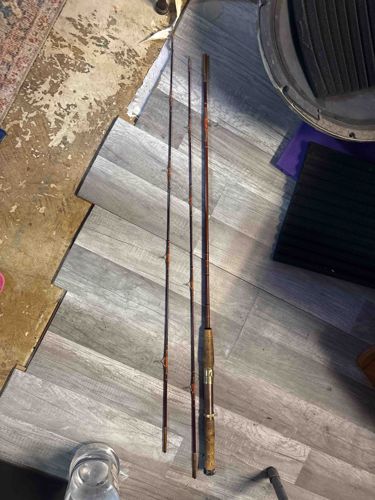
The item appears to be a vintage fishing rod, disassembled into three distinct sections. The primary material seems to be a dark-stained wood, possibly bamboo, with a somewhat aged and worn appearance, suggesting significant use and age. The rod sections exhibit a slender, tapering form typical of fishing rods. Orange-brown thread windings, likely securing line guides (though individual guides are not clearly visible), are intermittently spaced along the length of each section. The handle section, which is the thickest of the three, features a cork grip, showing noticeable signs of wear, discoloration, and some material loss, consistent with a well-used item. A metallic band, possibly brass or tarnished chrome, is visible on the handle, likely part of the reel seat mechanism. The overall color palette is dominated by dark browns and oranges from the rod and windings, contrasted by the lighter, aged cork. The connections between the rod sections are not visible, but they are clearly designed to fit together, indicating a multi-piece construction for portability. The visible condition suggests a utilitarian item that has seen active service, with wear commensurate with its age and intended purpose. There are no discernible maker's marks or signatures visible in the provided image. The style of construction and materials points to a manufacturing period likely mid-20th century or earlier, before the widespread adoption of fiberglass and graphite rods. The quality appears practical rather than purely decorative, focused on function.
AI Appraisal Report
I have thoroughly examined the provided image of the vintage multi-piece fishing rod. Based on the visual evidence, the item appears to be an authentic vintage fishing rod, likely constructed from dark-stained bamboo or similar wood, given its slender, tapering form and the appearance of the material. The presence of orange-brown thread windings aligns with traditional rod construction from the mid-20th century or earlier.
The condition, while showing clear signs of age and significant use, is consistent with an item of its type and probable age. The worn cork grip, discoloration, and material loss are indicative of a utilitarian tool that has seen active service. The lack of visible damage beyond wear and tear is positive, suggesting it remains functional, though this cannot be fully confirmed without physical inspection. The absence of maker's marks is a limiting factor for specific identification.
From a market perspective, vintage bamboo rods have a niche but consistent demand. However, the lack of a discernible maker, the general-purpose appearance, and the wear suggest it's more of a collector's item for enthusiasts of vintage tackle rather than a high-value piece. Without a known manufacturer like Hardy, Orvis, or Payne, its value is diminished. Comparables would be similar unmarked, well-used bamboo rods from the mid-20th century. Rarity is low for unmarked, utilitarian rods but higher for complete, functional, unrestored examples.
Key factors impacting value are the lack of a visible maker's mark, the used condition, and the absence of original case or accessories. Its value lies primarily in its historical charm and utility rather than investment potential. To fully authenticate its age, construction, and specific wood type, an in-person examination would be crucial. Microscopic analysis of the wood and thread, as well as a thorough inspection for internal markings or unique construction features, would be necessary for a definitive assessment. Provenance, such as original purchase receipts or family history, would also significantly aid in verification.