AI estimate as of November 27, 2025 · verify with a professional before acting
AI-Generated · Verify before acting
Everything on this page is generated by AI for informational purposes only. AI can make mistakes — the AI may misidentify items or misattribute them (artist, maker, brand, designer, origin, era). This is not an official valuation and should not be used for insurance, sale, tax, estate, legal, or lending purposes — or any decision requiring a certified appraisal. It is not an authoritative claim about any person, brand, or rights holder — do not share or rely on it as a factual statement about a third party. Always consult qualified professionals before making financial decisions.
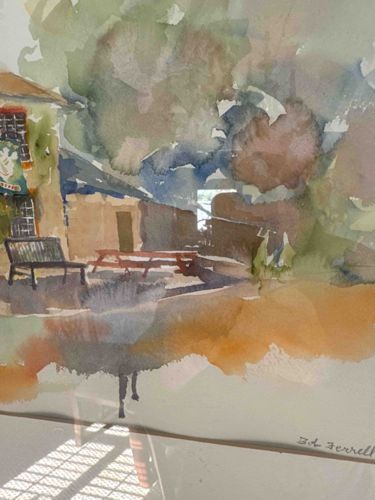
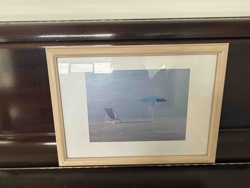
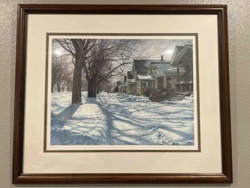
This item is a watercolor painting depicting an outdoor scene, likely a patio or courtyard area next to a building. The composition features a structure on the left side, characterized by a light-colored wall with visible windows and possibly an awning or sign above. A darker-toned bench is placed in front of this building. In the foreground and middle ground, there is a picnic table with benches, consistent with outdoor furniture. The background is dominated by lush, abstract foliage in shades of greens, blues, and browns, suggesting trees or bushes. The overall style is impressionistic, with loose brushstrokes and a soft, somewhat muted color palette characteristic of watercolor-specific techniques such as washes and wet-on-wet application, creating blended forms and subtle transitions. Some accidental drips and runs of paint are visible in the lower foreground, suggesting a spontaneous and expressive execution style, which some may consider a stylistic choice rather than a flaw. The colors predominantly include earthy tones of brown, beige, and orange for the ground and building, contrasted with verdant greens, deep blues, and hints of lavender in the foliage. Shadows are rendered in darker blues and grays, indicating a sunny day. The artwork appears to be framed, as evidenced by the glass reflection and a thin border visible at the bottom. A signature is present in the lower right corner, reading 'E.D. Ferrel', though the exact spelling of the last name might be 'Ferrell'. The visible condition includes reflections on the glass of the frame, which interfere slightly with the full view of the painting. The painting itself shows no obvious signs of damage or wear, maintaining its vibrant, though soft, original colors. Based on the style and discernible signature, it appears to be a contemporary or mid-20th century piece.
AI Appraisal Report
Upon examining the provided images of this watercolor painting by 'E.D. Ferrel' (or Ferrell), I assess it to be a competent and aesthetically pleasing work by a likely regional or amateur artist. The piece demonstrates a good handle on the watercolor medium, with its impressionistic style, loose brushwork, and effective use of washes to create a soft, atmospheric outdoor scene. The composition is pleasant, and the colors appear to be well-preserved, showing no signs of fading or damage, though it is viewed under glass which can obscure surface details.
The signature 'E.D. Ferrel' does not correspond to a widely known artist in major art databases, which places its market value in the decorative category rather than the fine art investment market. The primary value drivers for this piece are its decorative appeal, subject matter, and execution quality. The market for works by unlisted artists is typically localized and modest. Comparables would be other original, signed watercolor paintings of similar size and quality by unrecorded 20th-century artists, which generally trade in the low hundreds.
While the signature appears authentic to the piece, full authentication is impossible from images alone. An in-person examination is required to assess the paper quality, check for watermarks, and confirm that it is an original painting and not a print. Verifying the artist's identity would require genealogical or regional historical research, and any provenance (history of ownership) would significantly aid in establishing its origin and potential value.