AI Appraisal Estimate

AI-generated estimates · not official valuations

From the user

What was submitted

Photo and notes provided by the user — not generated by AI

Submitted item photo
Submitted photo · May 25, 2026

User's notes

No additional notes provided.

AI analysis below

AI appraisal

AI analysis & estimate

AI-Generated · Verify before acting

Everything below is generated by AI for informational purposes only. AI can make mistakes — the AI may misidentify items or misattribute them (artist, maker, brand, designer, origin, era). This is not an official valuation and should not be used for insurance, sale, tax, estate, legal, or lending purposes — or any decision requiring a certified appraisal. It is not an authoritative claim about any person, brand, or rights holder — do not share or rely on it as a factual statement about a third party. Always consult qualified professionals before making financial decisions.

Read the full disclaimer

AI Identification

·Not independently authenticated·Verify before acting

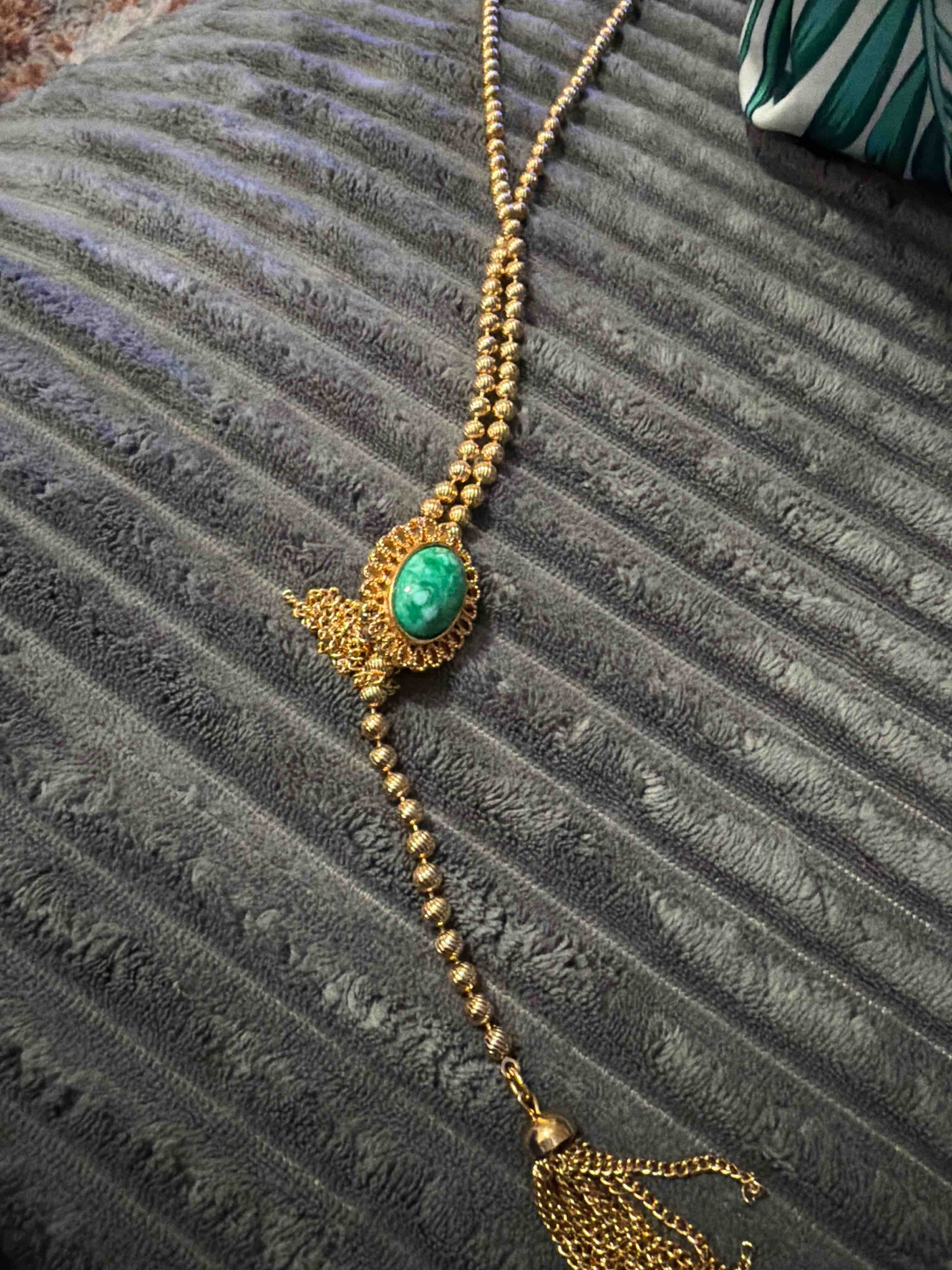
Vintage Gold-Tone Slotted-Bead Lariat Necklace with Green Faux-Jade Cabochon and Tassel

Vintage Costume Jewelry

AI Estimated Value

·Not an official valuation·Verify before acting

$45 - $65

As of May 25, 2026

AI Item Analysis

·AI can make mistakes·Verify before acting
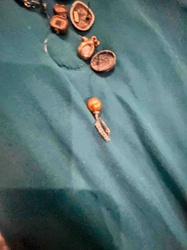
This is a vintage-style costume jewelry lariat necklace, approximately 24 to 30 inches in length, featuring a prominent yellow gold-tone finish. The primary chain consists of unique, textured 'slotted' or corrugated round beads. Central to the design is a large, oval, green mottled glass or resin cabochon meant to simulate jade, which is secured in a decorative raised bezel with an ornate scalloped or openwork filigree border. Adjacent to the central stone is a decorative floral or leaf-motif metal component. The necklace terminates in a multi-strand chain tassel capped with a smooth gold-tone dome. The construction indicates mid-to-late 20th-century costume jewelry, likely 1960s-1970s, reminiscent of brands like Sarah Coventry or Trifari. Geometrically, the piece displays a double-strand segment leading into the central charm, which acts as a sliding or fixed focal point. The condition appears fair to good; there is visible patina and minor brassing or finish loss on the textured beads and near the tassel cap, revealing a darker base metal underneath. The green stone appears intact without major chips, though the metalwork shows typical signs of surface wear and oxidation consistent with age. No designer hallmark is immediately visible in the provided image. The overall craftsmanship suggests a mass-market but well-detailed vanity piece of its era.
AI Appraisal Report

·AI can make mistakes·Verify before acting
Based on my visual examination of this vintage lariat necklace, I have identified it as a mid-century costume jewelry piece, likely produced between 1965 and 1975. The design—featuring textured 'slotted' beads and a faux-jade cabochon—is highly characteristic of the 'Bohemian Revival' period. While currently unsigned, the craftsmanship aligns with mass-market producers such as Sarah Coventry or Florenza. I observed visible finish loss (brassing) on the bead surfaces and tassel cap where the gold-tone plating has worn away to reveal the base metal. This wear, along with the oxidation noted on the filigree, places the condition in the 'fair-to-good' category. In the current secondary market, vintage costume jewelry of this era remains popular for collectors of 'statement' pieces, though values are suppressed by the lack of a designer hallmark and the visible condition issues. Comparable non-designer lariats from this period typically realize between $30 and $80 depending on the integrity of the plating. It is important to note that this appraisal is based on photographic evidence alone. A physical inspection is necessary to check for hidden hallmarks on the slide or tassel interior, and to determine if the 'stone' is glass or molded plastic, which affects durability and appeal. Furthermore, scientific testing (XRF) would be required to identify the exact composition of the base metal. Without provenance or a physical weight check, I cannot definitively rule out lower-quality reproductions, though the patina suggests authentic age.

Get your items appraised

Instant estimates of your treasures with AI-powered appraisals

Browse More Appraisals