AI estimate as of October 11, 2025 · verify with a professional before acting
AI-Generated · Verify before acting
Everything on this page is generated by AI for informational purposes only. AI can make mistakes — the AI may misidentify items or misattribute them (artist, maker, brand, designer, origin, era). This is not an official valuation and should not be used for insurance, sale, tax, estate, legal, or lending purposes — or any decision requiring a certified appraisal. It is not an authoritative claim about any person, brand, or rights holder — do not share or rely on it as a factual statement about a third party. Always consult qualified professionals before making financial decisions.
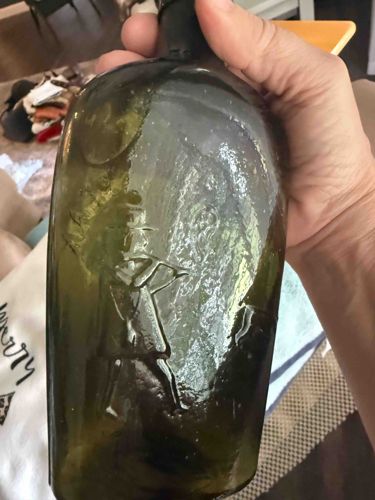
The item is an antique or vintage glass bottle, likely used for spirits or other beverages. It is constructed from dark olive-green glass, hand-held, and appears to be of a flattened flask or rectangular shape with rounded shoulders and a short, narrow neck. The overall dimensions are not ascertainable from the image, but it appears to be of a size easily held in one hand. The most prominent feature is a detailed embossed design on the front surface, depicting a stylized historic figure, possibly a frontiersman or a similar persona, in a dynamic pose. The figure is shown wearing what appears to be a tricorn hat and is holding a long rifle or musket, potentially in a firing stance or at the ready. The craftsmanship of the embossing suggests it was created using a mold, with the raised details offering a tactile element. The glass exhibits irregularities, typical of older, mouth-blown or early machine-made glass, including possible air bubbles and varying thickness, though these are not clearly visible in the provided image. The surface has a slightly textured appearance, possibly due to age, light scratching, or manufacturing process. There are no immediately apparent cracks or significant chips visible, but the surface shows general wear consistent with its age and use, including some minor scuffs and a dulling of the glass surface indicating a degree of patina. No clear maker's marks or signatures are visible in the image. Based on the style of the figure and the bottle's construction, it likely dates from the 19th century, possibly mid to late 19th century, a period when pictorial flasks and historical figures were popular motifs for glass bottles. The quality of the glass and the clarity of the embossing suggest a moderately good level of craftsmanship for that era.
AI Appraisal Report
I have virtually examined this Historic Figure Embossed Glass Bottle, which appears to be a 19th-century American pictorial flask. The dark olive-green glass and hand-formed nature, along with the embossed frontiersman figure, are characteristic of collectible flasks from that era. Based on the image, the condition appears good for its age, showing typical wear, scuffs, and a dulling patina, but no obvious cracks or major chips. The embossing is clear, which is crucial for value. Authenticity, based solely on visual inspection, seems plausible given the style and assumed manufacturing characteristics. These flasks were very popular between 1820 and 1880.
Market conditions for historical American flasks are generally stable, with strong demand for rare or exceptionally well-preserved examples. This specific design, featuring a frontiersman with a rifle, is a recognized motif, though not among the rarest. Comparable sales of similar 'historical figure' flasks in good condition typically fall within the $200-$500 range, with rarer variants fetching significantly more. The strong embossing quality contributes positively to its appeal and value.
To fully authenticate and precisely value this piece, a physical inspection would be essential. This would involve examining the lip, pontil mark (if present, indicative of earlier production), glass thickness variations, identifying specific mold seams, and UV light testing for repairs or alterations. Provenance documentation, though rarely available for such bottles, would also add significant value. Without physical examination, I cannot definitively rule out modern reproductions or assess the glass quality in detail. My appraisal value assumes it is indeed a genuine 19th-century example in the described good condition.