AI Appraisal Estimate

AI-generated estimates · not official valuations

From the user

What was submitted

Photo and notes provided by the user — not generated by AI

Submitted item photo
Submitted photo · June 4, 2026

User's notes

Canterbury glass

AI analysis below

AI appraisal

AI analysis & estimate

AI-Generated · Verify before acting

Everything below is generated by AI for informational purposes only. AI can make mistakes — the AI may misidentify items or misattribute them (artist, maker, brand, designer, origin, era). This is not an official valuation and should not be used for insurance, sale, tax, estate, legal, or lending purposes — or any decision requiring a certified appraisal. It is not an authoritative claim about any person, brand, or rights holder — do not share or rely on it as a factual statement about a third party. Always consult qualified professionals before making financial decisions.

Note

This analysis also relies on unverified notes provided by the user, which may be incomplete or inaccurate and could affect the result.

Read the full disclaimer

AI Identification

·Not independently authenticated·Verify before acting

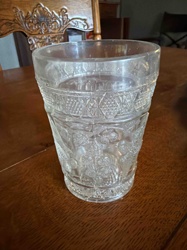
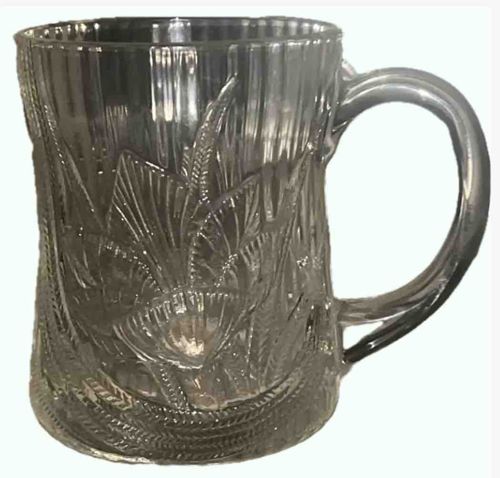
Cambridge Glass 'Canterbury' Pressed Glass Stein

Vintage American Glassware / Collectible Tableware

AI Estimated Value

·Not an official valuation·Verify before acting

$25.00 - $45.00

As of June 4, 2026

AI Item Analysis

·AI can make mistakes·Verify before acting
This item is a decorative clear glass mug or stein manufactured by the Cambridge Glass Company, specifically featuring the 'Canterbury' pattern (Pattern No. 119). The piece is constructed from heavy pressed glass with a high lead-like clarity characteristic of the mid-20th-century American Brilliant period survivors. Physically, the item stands approximately 4.5 to 5 inches tall, featuring a slightly tapered cylindrical body with a robust, thick-walled D-shaped handle attached to the side. The surface is heavily ornamented with deeply pressed intricate patterns, including stylized floral fan motifs, vertical ribbing at the top collar, and a textured wheat-like or herringbone border around the base. These facets are designed to catch and refract light, mimicking more expensive hand-cut crystal. In terms of condition, the glass appears bright with no significant clouding or 'glass sickness,' though minor surface scratches and shelf wear on the base are expected for an item of this vintage (circa 1930s-1950s). There are no visible chips or cracks in the main body or at the handle joinery. The craftsmanship is high-quality for press-molded glass, showing crisp edges in the mold design. This specific 'Canterbury' line was highly popular for its durability and formal aesthetic, making it a staple of Depression-era and mid-century American tableware.
AI Appraisal Report

·AI can make mistakes·Verify before acting
Based on my examination of the Cambridge Glass 'Canterbury' (Pattern No. 119) stein, I have assessed the item as a well-preserved example of mid-20th-century pressed glass. The clarity of the glass and the sharpness of the mold lines suggest a production period between the 1930s and 1950s. The piece exhibits the standard characteristics of the Cambridge Glass Company’s high-quality manufacturing, specifically the 'D' handle and the fan motifs that define the Canterbury line. Condition is consistent with light domestic use; the absence of chips at the handle joints and the base—common fail points for heavy glass—is a positive factor for collectors. Market demand for clear pressed glass currently remains stable but modest. The 'Canterbury' pattern was produced in significant quantities, which limits its rarity compared to Cambridge's colored or etched lines. Recent auction and secondary market sales for similar clear steins often fall within the $25-$45 range depending on the buyer's regional interest in American glass. Limitations: This appraisal is based on visual examination via digital imagery. I cannot verify the presence of 'sick glass' or internal annealing cracks not visible under flat lighting. A physical inspection would be required to confirm the lack of microscopic repairs or to detect the signature 'C in a triangle' mark, which was not always present on this line. Full authentication would benefit from UV light testing to observe fluorescence patterns consistent with glass formulas used by Cambridge during the Depression era.

Get your items appraised

Instant estimates of your treasures with AI-powered appraisals

Browse More Appraisals