AI estimate as of September 13, 2025 · verify with a professional before acting
AI-Generated · Verify before acting
Everything on this page is generated by AI for informational purposes only. AI can make mistakes — the AI may misidentify items or misattribute them (artist, maker, brand, designer, origin, era). This is not an official valuation and should not be used for insurance, sale, tax, estate, legal, or lending purposes — or any decision requiring a certified appraisal. It is not an authoritative claim about any person, brand, or rights holder — do not share or rely on it as a factual statement about a third party. Always consult qualified professionals before making financial decisions.
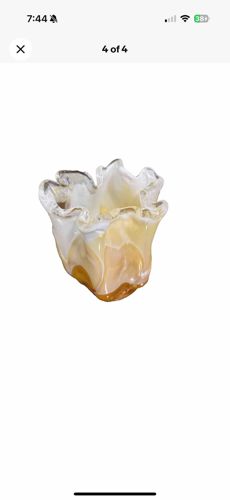
This item is an artistic glass vessel, likely a small bowl or vase, characterized by its distinctive ruffled or crimped rim. The glass exhibits a compelling play of colors, primarily white and various shades of amber and light brown, which appear to swirled and integrated within the glass matrix, suggesting an opalescent or alabasterine effect. The base of the vessel transitions to a more saturated, rich amber tone, potentially indicating a varied glass composition or a technique such as cased glass, though without better views of the cross-section, this is speculative. The form is organic and free-flowing, with the upper edge terminating in irregular, undulating folds that create visual interest and a sense of movement. The surface appears smooth and glossy, reflecting light. The craftsmanship suggests hand-blown or artisan-made glass, as evidenced by the irregular shape and the seamless color blending. There are no visible chips, cracks, or repairs in the provided image, indicating it is in good, if not excellent, condition. The style points towards mid-20th century to contemporary art glass, possibly Murano or studio glass, given the artistic manipulation of color and form, although no specific maker's marks are visible. The quality of the glass appears high, with good clarity in the lighter areas and rich saturation in the amber sections, suggesting skilled glassworking.
AI Appraisal Report
Upon visual examination of the provided image, this Art Glass Ruffled Bowl or Vase presents as a well-preserved piece. I see no visible chips, cracks, or repairs, suggesting it is in good to excellent condition. The organic form with its undulating, ruffled rim, combined with the swirled white and amber opalescent glass, is aesthetically pleasing and indicative of skilled craftsmanship, likely hand-blown. The transition to a richer amber tone at the base adds depth and visual interest. This style is consistent with mid-20th century to contemporary art glass, often associated with studio glass movements or Italian makers like Murano, though without specific marks, attribution remains speculative.
Market conditions for unsigned art glass of this type are generally moderate. While attractive and well-made, the absence of a known maker or definitive provenance limits its 'collectible' premium. Comparable unsigned art glass pieces in similar condition and quality typically sell in the $100-$300 range at auction or through reputable dealers. Demand is steady for decorative art glass, but rarity for unsigned pieces is not high unless a unique quality or historical significance can be established.
Factors significantly impacting this value include its current excellent condition and its decorative appeal. However, the biggest limitation on value and authenticity verification from an image alone is the lack of maker's marks or a tangible connection to a celebrated artist or studio. For full authentication and to ascertain a more precise origin (e.g., Murano, specific studio), an in-person examination would be critical to assess the glass's weight, pontil mark, subtle textural qualities, and potential hidden signatures. Provenance documentation, if available, would also be invaluable. Scientific testing, such as elemental analysis, could further clarify its composition and origin but is rarely justified for pieces in this value range unless provenance is highly contested.