AI identification & appraisal estimate

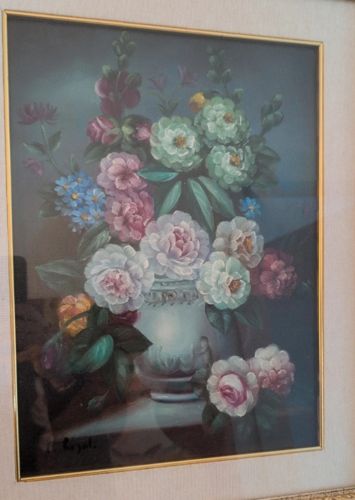
Floral Still Life by Carlo Rigoli

Submitted photo of Floral Still Life by Carlo Rigoli
Photo submitted by the user — not generated by AI

User's notes

Carlo Rigoli

These notes were written by the person who submitted this item. Appraiser.AI has not verified them, and the AI's identification and estimate may rely on them.

AI Estimated Value

Not an official valuation

$4,000 - $6,000

AI estimate as of January 10, 2026 · verify with a professional before acting

AI-Generated · Verify before acting

Everything on this page is generated by AI for informational purposes only. AI can make mistakes — the AI may misidentify items or misattribute them (artist, maker, brand, designer, origin, era). This is not an official valuation and should not be used for insurance, sale, tax, estate, legal, or lending purposes — or any decision requiring a certified appraisal. It is not an authoritative claim about any person, brand, or rights holder — do not share or rely on it as a factual statement about a third party. Always consult qualified professionals before making financial decisions.

This analysis also relies on unverified notes provided by the user, which may be incomplete or inaccurate and could affect the result.

Read the full disclaimer

AI Item Analysis

This item is an original oil painting on canvas by the Italian artist Carlo Rigoli (1883-1964). The artwork depicts a lush, classical floral arrangement featuring an assortment of roses, peonies, and smaller accent blooms such as blue forget-me-nots and purple stock. The flowers are rendered in a soft, romantic palette of pale pinks, creams, mint greens, and vibrant blues, arranged within a ceramic or porcelain urn that sits upon a dimly lit stone ledge. The background is composed of deep, atmospheric shadows that emphasize the luminosity of the floral subjects. The brushwork exhibits a fine, painterly quality typical of the early to mid-20th-century Italian academic style, focusing on light play and organic texture. The piece is signed 'C. Rigoli' in the lower-left corner in a dark, legible script. The painting is housed in a modern gold-toned metal frame with a wide fabric mat, indicating it was likely reframed in the late 20th century. The visible condition of the canvas appears stable, though there is a faint horizontal reflection on the right side from protective glazing. No major craquelure or pigment loss is immediately visible in the provided image. Rigoli's work often bridges the gap between traditional still life and the decorative sensibilities of the Art Nouveau period, showing high craftsmanship in the delicate layering of petals and realistic leaf structures.

AI Appraisal Report

Based on my visual examination of the digital images provided, this work appears to be an authentic floral still life by Carlo Rigoli (1883-1964). The painting demonstrates Rigoli’s characteristic technical proficiency, specifically his ability to balance academic realism with the soft, decorative luminosity of the early 20th-century Italian school. The brushwork in the peonies and roses is executed with a confident impasto that suggests life and movement, while the high-contrast 'chiaroscuro' background effectively isolates the subject. The signature 'C. Rigoli' in the lower-left quadrant aligns with known examples of his autograph. The condition appears stable; however, the presence of protective glazing suggests the work has been well-maintained, though it obscures some surface texture. The modern framing, while functional, does not add significant historical value. Market demand for Rigoli remains steady among collectors of European academic still lifes, with his floral compositions generally fetching higher premiums than his landscapes. Comparables for works of this scale and detail typically range between $3,500 and $7,500 at specialist auctions. Value is slightly tempered by the fact that the work has been reframed, potentially hiding original canvas edges. Please note: This appraisal is based solely on photographic evidence. A definitive authentication requires a physical inspection to verify the canvas weave, examine the aging of the pigment under ultraviolet light, and review provenance documentation. Scientific testing of the binder and pigments would be necessary to rule out high-quality period copies. Any evidence of past restoration or relining found during an in-person assessment could also impact the final valuation.

Keep exploring

More fine art - paintings appraisals

Get your items appraised

Instant AI-powered appraisal estimates from a photo

Browse More Appraisals