AI estimate as of August 3, 2025 · verify with a professional before acting
AI-Generated · Verify before acting
Everything on this page is generated by AI for informational purposes only. AI can make mistakes — the AI may misidentify items or misattribute them (artist, maker, brand, designer, origin, era). This is not an official valuation and should not be used for insurance, sale, tax, estate, legal, or lending purposes — or any decision requiring a certified appraisal. It is not an authoritative claim about any person, brand, or rights holder — do not share or rely on it as a factual statement about a third party. Always consult qualified professionals before making financial decisions.
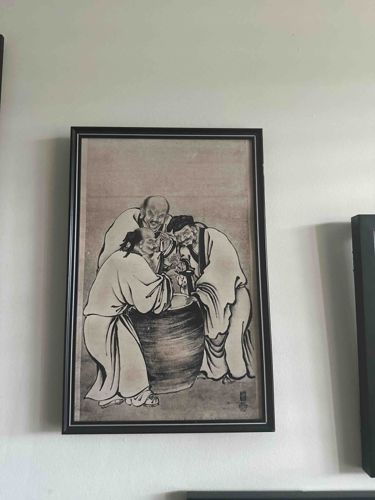
The item is a framed piece of artwork, likely a print or reproduction, depicting a traditional East Asian scene. The artwork itself is rendered in a monochromatic palette, primarily using black ink on what appears to be a light beige or off-white paper, giving it a somewhat aged or vintage aesthetic. The subject matter features three figures, presumably Chinese or Japanese monks or scholars, gathered around a large, dark-colored barrel or vat. The figures are depicted in a somewhat exaggerated, caricatured style, with visible expressions of intrigue or perhaps amusement as they peer into the container. One figure, bald, is positioned at the top center, looking down. Another figure to the left is kneeling and looking into the barrel, while a third figure to the right is also leaning in. Their robes are simple, flowing, and rendered with broad, expressive brushstrokes, highlighting the movement and posture of the figures. The background is minimal, focusing attention on the figures and the barrel. In the lower right corner of the artwork, there is a small, red seal or chop mark, which is characteristic of traditional East Asian art and may signify the artist's signature or studio. The artwork is housed within a simple black frame, which appears to be made of wood or a similar material, with a smooth, matte finish. The frame has a classic profile, providing a clean border to the artwork. There does not appear to be a mat board separating the artwork from the frame. The visible condition of the artwork and frame appears good, with no obvious signs of damage, fading, or wear from the provided image. The overall style suggests an influence from traditional Chinese ink wash painting or Japanese ukiyo-e, possibly from the Edo period or later, although without clear markings, it's difficult to ascertain its exact age or the identity of the artist.
AI Appraisal Report
Upon examining the provided image of the 'Three Scholars/Monks Examining a Barrel' framed print, I assess its condition as good. The print itself shows no visible signs of fading, water damage, or significant creasing. The black frame appears to be in good order, free from major scratches or chips. Authenticity, however, is difficult to verify solely from an image. While the style strongly parallels traditional East Asian ink wash and Ukiyo-e, characteristic of periods like Edo, determining if this is an original woodblock print, a later reproduction, or even a contemporary piece requires physical inspection. The small red seal or chop mark is a good sign but needs closer examination to identify the artist or studio.
In terms of market conditions, similar framed East Asian-inspired prints, especially reproductions or decorative pieces, typically fall into a modest price range. There's a decent demand for decorative art that evokes traditional Eastern aesthetics, particularly if well-framed and in good condition. Rarity is harder to gauge; if it's a mass-produced reproduction, it's not rare. If it were an original antique woodblock, its rarity and value would increase significantly.
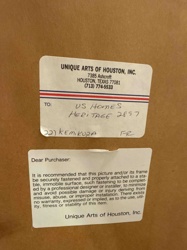
Factors impacting value include its true age, the technique (original woodblock vs. modern print), the artist's identity (if known), and provenance. Without in-person examination, I cannot confirm if it's an original woodblock print or a photographic reproduction. Full authentication would necessitate a physical inspection to analyze paper type, printing technique (e.g., discernible wood grain from block printing), ink quality, and detailed examination of the seal. Provenance documentation, if available, would also be critical for historical context and authenticity.