AI Appraisal Estimate

AI-generated estimates · not official valuations

From the user

What was submitted

Photo and notes provided by the user — not generated by AI

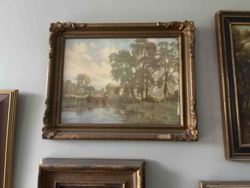
Submitted item photo
Submitted photo · June 18, 2026

User's notes

No additional notes provided.

AI analysis below

AI appraisal

AI analysis & estimate

AI-Generated · Verify before acting

Everything below is generated by AI for informational purposes only. AI can make mistakes — the AI may misidentify items or misattribute them (artist, maker, brand, designer, origin, era). This is not an official valuation and should not be used for insurance, sale, tax, estate, legal, or lending purposes — or any decision requiring a certified appraisal. It is not an authoritative claim about any person, brand, or rights holder — do not share or rely on it as a factual statement about a third party. Always consult qualified professionals before making financial decisions.

Read the full disclaimer

AI Identification

·Not independently authenticated·Verify before acting

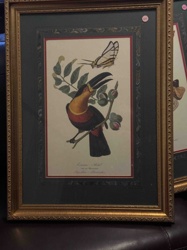
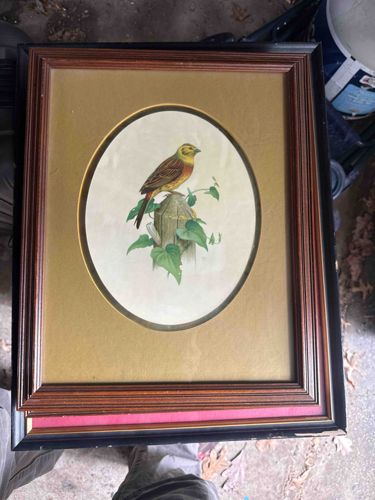
Vintage Framed Bird Lithograph - Yellow Bunting

Fine Art / Decorative Prints

AI Estimated Value

·Not an official valuation·Verify before acting

$45.00 - $75.00

As of June 18, 2026

AI Item Analysis

·AI can make mistakes·Verify before acting
This item is a vintage ornithological lithograph or art print depicting a yellow-headed bird, likely a Yellow Bunting or similar species, perched atop a weathered wooden fence post entwined with leafy green ivy. The central artwork is presented within an oval-shaped matting or border of aged ivory/parchment color, further set against an ochre-toned secondary mat. The print exhibits fine-line detailing in the plumage and vegetation, characteristic of mid-20th-century natural history illustrations. The framing consists of a multi-tiered wooden structure; the primary frame is a mid-tone brown with a tiered, ridged profile, which is then nested within a larger black outer frame with a thin red accent strip visible at the bottom edge. Physical condition notes include noticeable scuffing and paint loss on the lower-right corner of the black outer frame, as well as a general layer of surface dust and minor corner wear consistent with age and storage in a non-climate-controlled environment. The artwork appears to be a mass-produced decorative print rather than an original watercolor or rare early-edition plate, likely dating from the mid to late 20th century. Craftsmanship of the framing is robust, utilizing a 'stacked' frame style to add depth and visual weight to the relatively small subject matter.
AI Appraisal Report

·AI can make mistakes·Verify before acting
I have conducted a formal visual examination of the Vintage Framed Bird Lithograph. The piece depicts a Yellow Bunting executed in a style common to mid-20th-century natural history decorative prints. My assessment reveals a mass-produced offset lithograph rather than a hand-colored plate or original work. The 'stacked' framing technique—using a tiered inner wood frame within a black outer shadowbox—is consistent with high-volume decorative art production from the 1960s or 1970s. The condition is fair; while the print appears stable, there is significant cosmetic damage to the outer frame, specifically paint loss and scuffing on the lower-right corner, which detracts from its display value. The market for this type of reproduction is currently saturated. Comparable items from companies like Turner Wall Accessory or similar mid-century décor manufacturers frequently appear at estate sales and online marketplaces. Demand remains stable for 'Cottagecore' or traditional aesthetics, but the lack of an artist signature or a high-end publisher (such as Audobon/Havell) keeps the value in the decorative tier rather than the fine art tier. Critically, a definitive authentication of the printing method (e.g., identifying halftone dot patterns vs. lithographic grain) is limited by regional image resolution. To move beyond this 'Fair Market Value' for decorative purposes, an in-person inspection would be required to examine the paper’s watermark, acidity levels, and the presence of any plate marks. Provenance documentation or a manufacturer’s label on the dust cover (versos) would be necessary to identify the specific publishing house. Without these, the value remains primarily in its utility as a vintage decorative object.

Get your items appraised

Instant estimates of your treasures with AI-powered appraisals

Browse More Appraisals