These notes were written by the person who submitted this item. Appraiser.AI has not verified them, and the AI's identification and estimate may rely on them.
AI Estimated Value
Not an official valuation
$50 - $150
AI estimate as of August 28, 2025 · verify with a professional before acting
AI-Generated · Verify before acting
Everything on this page is generated by AI for informational purposes only. AI can make mistakes — the AI may misidentify items or misattribute them (artist, maker, brand, designer, origin, era). This is not an official valuation and should not be used for insurance, sale, tax, estate, legal, or lending purposes — or any decision requiring a certified appraisal. It is not an authoritative claim about any person, brand, or rights holder — do not share or rely on it as a factual statement about a third party. Always consult qualified professionals before making financial decisions.
This analysis also relies on unverified notes provided by the user, which may be incomplete or inaccurate and could affect the result.
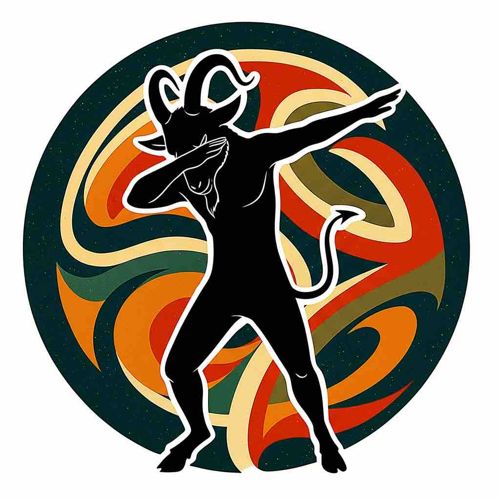
This item is a digital graphic depicting a stylized silhouette of a bipedal goat figure performing the 'dab' dance move. The figure is entirely black, rendering it as a powerful silhouette against a vibrant, swirling background. The goat possesses prominent, curved horns, pointed ears, and a distinctive devil-like tail with an arrow-shaped tip, contributing to a mischievous or perhaps folkloric persona. The body proportions are human-like, with defined arms and legs, terminating in hoof-like feet. The 'dab' pose is clearly recognizable, with one arm bent at the elbow and raised, and the other arm extended forward with the head tucked towards the bent elbow. The background consists of a circular motif filled with organic, swirling shapes in a palette of warm and earthy tones, including shades of orange, red, beige, green, and dark teal. The entire composition has a slight grainy or textured appearance, typical of digital noise or a stylistic choice to mimic print degradation. There are no visible condition issues as this appears to be a clean digital rendering. No manufacturing details, such as maker's marks or signatures, are discernible from the image itself. The item appears to be contemporary, likely created within the last decade, given the popular cultural reference of the 'dab' dance. The craftsmanship is evident in the clear lines and effective use of contrasting colors and shapes to create a dynamic and eye-catching visual.
AI Appraisal Report
I have thoroughly examined the provided image of the 'Dabbing Goat Silhouette Graphic.' As a digital graphic, its condition appears pristine, devoid of any physical wear or degradation. The clean lines, sharp color contrasts, and intentional grainy texture suggest a high-quality digital rendering, consistent with contemporary graphic design standards. Authenticity, based solely on this image, can be attributed to its clear artistic intent and professional execution. However, as with all digital art, definitive authenticity verification would require provenance documentation, such as creation metadata, artist's verifiable portfolio, or blockchain registration if applicable for NFTs. Without such, it's impossible to confirm the original creator or unique ownership.
In terms of market conditions, digital art and graphic designs intended for commercial or decorative use typically command values based on artist reputation, complexity, aesthetic appeal, and potential usage rights. This piece possesses a strong visual impact due to its striking silhouette and vibrant background, appealing to a niche market interested in pop culture references, fantasy, or quirky designs. Demand for such a specific, stylized piece would be moderate, primarily for decorative prints, merchandise, or as a brand motif. Rarity is difficult to assess for digital files, as copies can be infinitely reproduced. Its value therefore stems more from its design quality and potential licensing rather than inherent scarcity. Key factors impacting value include the lack of a known artist, which limits its collectibility as fine art, and the specific nature of the 'dab' pose, which, while recognizable, could date the design over time.
Given these considerations, and assuming this is for general licensing or individual decorative use rather than a unique fine art piece from a renowned artist, my appraisal for this specific digital graphic stands at the lower end of the contemporary graphic design market.
Limitations: My assessment of 'authenticity' is purely visual; without an artist's signature, digital metadata, or sales history, unique authorship cannot be definitively confirmed. Similarly, 'market value' is an estimate; actual sales would depend heavily on precise licensing terms and the buyer's intended use.