AI estimate as of September 3, 2025 · verify with a professional before acting
AI-Generated · Verify before acting
Everything on this page is generated by AI for informational purposes only. AI can make mistakes — the AI may misidentify items or misattribute them (artist, maker, brand, designer, origin, era). This is not an official valuation and should not be used for insurance, sale, tax, estate, legal, or lending purposes — or any decision requiring a certified appraisal. It is not an authoritative claim about any person, brand, or rights holder — do not share or rely on it as a factual statement about a third party. Always consult qualified professionals before making financial decisions.
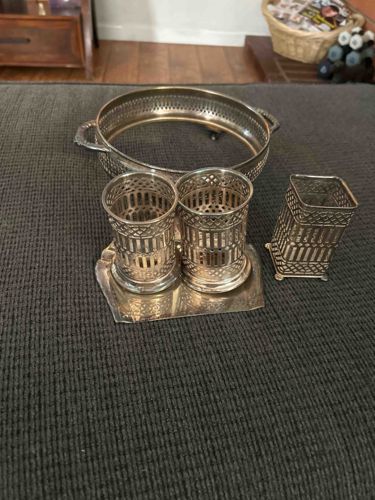
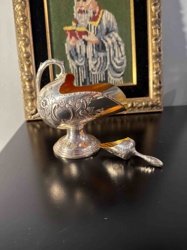
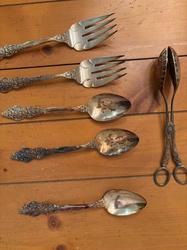
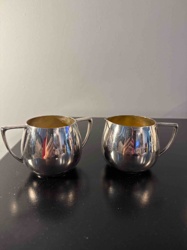
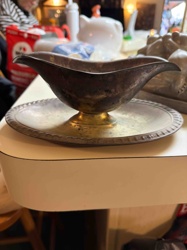
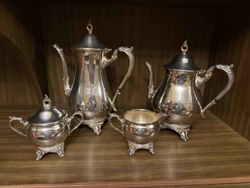
The image displays a collection of silver-toned metal tableware pieces, likely silver-plated or sterling silver, exhibiting ornate filigree and pierced work. The main items consist of a circular serving tray with handles, a cruet stand holding two cylindrical holders, and a separate rectangular holder. The circular tray features a pierced, floral, or geometric pattern along its raised rim, with two small handles protruding horizontally. The surface of the tray appears flat but shows some signs of tarnish and possibly scratches from use. The cruet stand is rectangular with rounded corners, featuring engraved or embossed scrolling patterns on its base. It supports two identical cylindrical holders, which are intricately pierced with multiple rows of various patterns, including vertical bands and diamond-like shapes, indicating fine craftsmanship. These holders are designed to cradle glass or ceramic cruets, likely for salt, pepper, oil, or vinegar. The separate rectangular holder is taller and more slender than the cylindrical ones, also featuring elaborate pierced designs on all four sides and a sturdy base. All pieces show significant tarnish, suggesting age and a need for cleaning, but no obvious major damage like dents or breaks. The consistent design elements across all components suggest they may be part of a matched set. The intricate detailing points towards a late 19th to early 20th-century aesthetic, possibly Victorian or Edwardian eras, emphasizing decorative ornamentation popular at the time. The visible patina indicates original surface condition without excessive polishing or restoration, which can be desirable for antique items. The craftsmanship appears to be of good quality, with precise piercing and consistent patterns.
AI Appraisal Report
Based on my visual examination of the image provided, this Antique Silver-Toned Cruet Set and Serving Dish appears to be a charming example of late 19th to early 20th-century decorative tableware. The ornate filigree and pierced work, consistent across all pieces, strongly suggest they belong to a matched set, likely from the Victorian or Edwardian era. The craftsmanship, particularly the detailed piercing on the cruet holders, is of good quality.
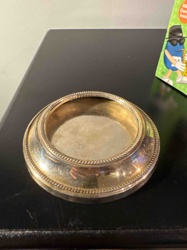
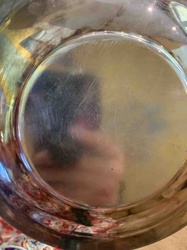
The condition, as observed, indicates significant tarnish across all components, which is consistent with age and lack of recent polishing. While tarnish doesn't inherently devalue an item, it does suggest the pieces have been stored rather than actively used or maintained. I see no obvious signs of major damage such as significant dents, breaks, or missing parts, though a closer inspection would be needed to confirm the absence of hairline cracks or subtle repairs. The 'silver-toned' description is key here; without physical examination or hallmarks, it's impossible to definitively determine if it's sterling silver, Sheffield plate, or another silver-plated metal, which significantly impacts value. My appraisal assumes these are good quality silver-plated items.
In terms of market conditions, cruet sets and ornate serving pieces from this period generally have a steady, albeit moderate, demand among collectors of antique silver-plated items. They are not exceedingly rare, and numerous similar pieces come up for sale. Comparables suggest that well-preserved silver-plated sets of this intricacy typically fall within this value range. Factors impacting value positively include the completeness of the set, the detailed craftsmanship, and the apparent lack of major damage. The tarnish is a minor detractor but easily remedied with proper cleaning.
My primary limitation in fully authenticating this item is the visual nature of the assessment. To confirm authenticity and material composition (e.g., sterling silver vs. silver plate), an in-person examination is crucial to identify any hallmarks or maker's marks, assess weight, and conduct potential acid tests. Provenance documentation, if available, would also greatly enhance authenticity verification and add to the item’s value. Without these, my appraisal is based solely on the visual characteristics and assumes typical market conditions for a well-made, antique silver-plated set.