AI estimate as of July 19, 2025 · verify with a professional before acting
AI-Generated · Verify before acting
Everything on this page is generated by AI for informational purposes only. AI can make mistakes — the AI may misidentify items or misattribute them (artist, maker, brand, designer, origin, era). This is not an official valuation and should not be used for insurance, sale, tax, estate, legal, or lending purposes — or any decision requiring a certified appraisal. It is not an authoritative claim about any person, brand, or rights holder — do not share or rely on it as a factual statement about a third party. Always consult qualified professionals before making financial decisions.
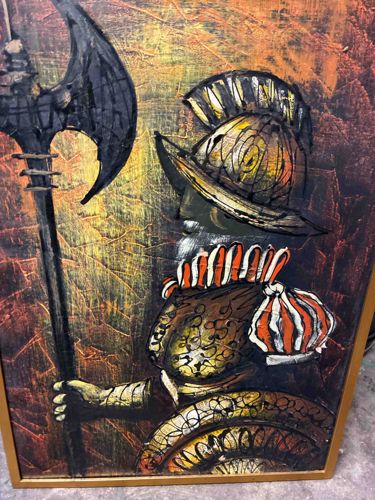
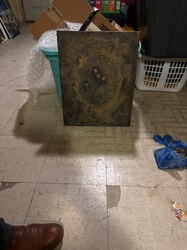
This appears to be a mixed media relief artwork, likely created using canvas or board as a base, with applied textures and paint. The primary subject is a stylized, bust-level depiction of what seems to be a conquistador or a similar historical warrior figure from the side, holding a large medieval halberd or battle axe. The overall coloration is warm, featuring earthy tones of oranges, browns, and yellows, with some stark black and white contrasts. The background suggests an abstract, textured landscape or wall, achieved through impasto techniques and possibly sgraffito, where layers of paint are scratched through to reveal underlying colors. The figure itself exhibits distinct raised textures, particularly noticeable on the helmet, the patterned armor, the ruffed collar (white and red striped), and the weapon. The outlines of the figure and weapon are sharply defined in black. There's a notable use of gold or brassy metallic accents, especially on the helmet and breastplate, adding a sense of richness and age. The painting uses a deliberately rough, almost brutalist aesthetic in its textural application, giving it a somewhat primitive yet bold character. The visible condition shows some wear, particularly around the edges of the frame and possibly minor scuffing or dust accumulation on the surface textures. The frame itself is a simple, thin gold-toned wooden or metallic profile, suggesting a mid-20th century aesthetic, perhaps 1960s or 1970s. The craftsmanship is evident in the dimensional quality and the expressive use of texture and color, though specific maker's marks are not visible in the provided image.
AI Appraisal Report
Upon visual examination of this 'Textured Conquistador with Halberd Relief Painting,' I assess its condition as good vintage, consistent with an item of its presumed age. There is visible wear around the frame edges and some surface accumulation which is typical for textural pieces, but no major damage such as cracks or significant paint loss. Authenticity is difficult to definitively confirm from images alone; however, the style, materials (mixed media relief, likely oil or acrylic on board), and textural application appear consistent with mid-20th century decorative arts, possibly originating from the 1960s or 1970s. The gold-toned thin frame supports this assessment.
Market conditions for vintage relief art, particularly figurative pieces of this scale and distinctiveness, generally show moderate demand. While not a high-demand collectible category unless attributed to a known artist, pieces with strong aesthetic appeal and good condition do find buyers. Comparables would include other unsigned mixed media relief works from the mid-century period, often found in estate sales, vintage art markets, or online secondary platforms. Its uniqueness and expressive, almost brutalist, textural quality elevates it slightly above generic mass-produced decor. Rarity is moderate; similar techniques were explored, but the specific subject matter and execution combination make this piece somewhat distinctive rather than truly rare.
Factors significantly impacting value include its appealing visual presence, the evident artistic skill in manipulating texture, and its solid vintage condition. The lack of a visible signature or provenance heavily limits its value to the decorative art market rather than the fine art market. Without an artist attribution, its primary appeal is its aesthetic merit and historical period charm. For full authentication and a more precise valuation, an in-person examination would be critical to confirm material composition, assess structural integrity, and search for very subtle hidden marks. Provenance documentation (e.g., original purchase receipts, exhibition history) would be invaluable, and scientific testing like pigment analysis could confirm age but would likely be cost-prohibitive for an item of this current valuation.
Considering these factors, this piece holds value primarily as a decorative vintage artwork rather than a significant collectible or investment.