AI estimate as of September 28, 2025 · verify with a professional before acting
AI-Generated · Verify before acting
Everything on this page is generated by AI for informational purposes only. AI can make mistakes — the AI may misidentify items or misattribute them (artist, maker, brand, designer, origin, era). This is not an official valuation and should not be used for insurance, sale, tax, estate, legal, or lending purposes — or any decision requiring a certified appraisal. It is not an authoritative claim about any person, brand, or rights holder — do not share or rely on it as a factual statement about a third party. Always consult qualified professionals before making financial decisions.
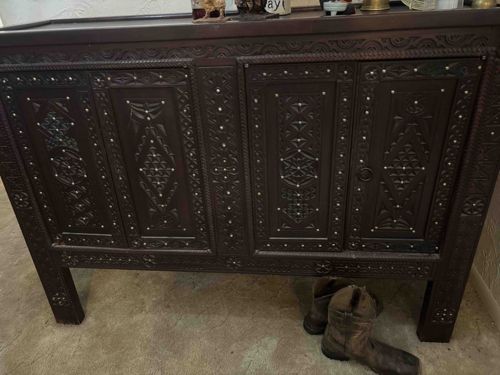
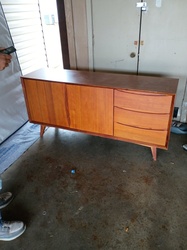
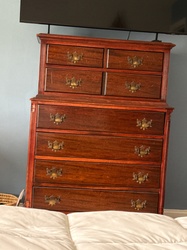
This is a dark-stained wooden cabinet, likely a side-table or a small buffet, characterized by extensive and intricate carving and decorative inlay. The cabinet features a rectangular top and is supported by four solid, straight legs that appear to be integrated into the cabinet's structure. The primary facade consists of four doors, two on each side of a central division, suggesting internal storage compartments. Each door panel, as well as the surrounding frame, is deeply carved with a variety of geometric and stylized floral or foliate patterns. These carvings create a rich, textured surface. Enhancing the carved details are numerous small, circular metal studs or tacks, possibly brass or pewter, strategically placed to highlight the patterns – a technique known as 'nailhead' or 'studding'. The overall color is a deep, rich brown, indicating a dark stain or perhaps a naturally dark wood like mahogany or walnut, although without closer inspection, the specific wood type is difficult to ascertain. The craftsmanship appears to be hand-carved, given the slight irregularities and depth of the patterns. The style suggests an antique or vintage piece, possibly from an Asian or Middle Eastern origin, reflecting a traditional aesthetic. There are no obvious signs of significant damage such as large cracks or missing pieces, but the dark finish and image resolution make it difficult to assess minor wear, scratches, or the condition of the metal studs. The top surface, partially visible, appears flat and unadorned, potentially serving as display space. The cabinet exudes a robust and sturdy construction, indicating good quality and durability. The general aesthetic is one of rustic elegance with a focus on detailed surface ornamentation.
AI Appraisal Report
Based on my visual examination of the provided image, I assess this Carved Wooden Cabinet with Inlay to be a well-crafted piece, likely an antique or vintage item. The dark-stained wood, intricate deep carvings featuring geometric and stylized floral patterns, and the strategic use of small circular metal studs (nailhead/studding) suggest a Middle Eastern or Asian aesthetic, possibly Moroccan or Indian. The robust construction points to good quality and durability. The craftsmanship appears to be hand-carved, which adds to its authenticity and appeal. I observe no overt signs of significant damage such as large cracks or missing components, suggesting a good overall condition for its presumed age. However, the dark finish and image resolution limit a thorough assessment of minor wear, scratches, or the exact condition of the metal studs.
Market conditions for intricately carved ethnic furniture are generally stable, with demand often driven by niche collectors or those seeking unique decorative accents. Comparable items with similar levels of detail and perceived age typically fetch prices in the mid-range for antique furniture. The hand-carved nature and decorative inlay contribute positively to its value, indicating a higher level of artisanal effort. Rarity is moderate; while such pieces are not unique, this specific design and level of detail are not mass-produced.
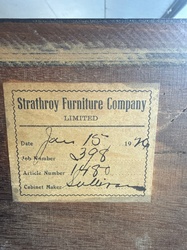
Factors significantly impacting value include the authentic hand-carved nature, the overall good condition, and its decorative appeal. Limitations in verifying authenticity from an image alone are significant. A hands-on examination would be crucial to determine the specific wood type, confirm if carvings are entirely hand-done versus partially machine-assisted, ascertain the metal composition of the studs, and thoroughly inspect for restorations, repairs, or more subtle condition issues. Provenance documentation, if available, would provide invaluable context regarding its origin, age, and previous ownership, which could substantially impact its value. Scientific testing such as wood dating could establish a precise age.