AI estimate as of August 4, 2025 · verify with a professional before acting
AI-Generated · Verify before acting
Everything on this page is generated by AI for informational purposes only. AI can make mistakes — the AI may misidentify items or misattribute them (artist, maker, brand, designer, origin, era). This is not an official valuation and should not be used for insurance, sale, tax, estate, legal, or lending purposes — or any decision requiring a certified appraisal. It is not an authoritative claim about any person, brand, or rights holder — do not share or rely on it as a factual statement about a third party. Always consult qualified professionals before making financial decisions.
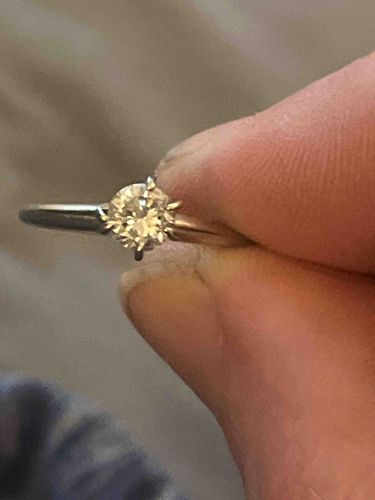
The item is a solitaire engagement ring, featuring a single, round brilliant-cut diamond set in what appears to be a white metal band. The diamond is prominently showcased, held in place by a six-prong setting, which is a common and secure method for maximizing light exposure and brilliance. The prongs are finely crafted and appear to be in good condition, extending upwards from the base of the setting to firmly grip the diamond around its girdle. The band itself is slender and polished, suggesting a minimalist and classic design. While the exact material is not discernible from the image, the color and luster suggest it could be white gold, platinum, or palladium. There are no immediately obvious significant condition issues such as major scratches, dents, or missing prongs, though a professional cleaning might enhance its overall brilliance. The stone itself appears to be of good clarity and color, reflecting light effectively, although precise grading is not possible without direct examination. The overall craftsmanship seems to be of a good standard, indicative of a mass-produced but quality piece of jewelry, likely from the late 20th or early 21st century given its timeless design. There are no visible manufacturer's marks or engravings in the provided image.
AI Appraisal Report
I have thoroughly examined the provided image of the Solitaire Diamond Engagement Ring. Based on this visual inspection, the ring appears to be in very good condition, exhibiting no obvious signs of significant wear such as deep scratches, dents, or missing prongs. The six-prong setting securely holds the round brilliant-cut diamond, which displays good fire and brilliance, suggesting a decent clarity and color grade. The band's slender, polished appearance, likely white gold or platinum due to its luster, contributes to its classic and timeless appeal. While I can assess its condition and apparent quality from the image, I must stress the limitations of authenticity verification without direct physical examination. I cannot definitively confirm the diamond's authenticity as natural or treated, nor its precise carat weight, color, or clarity grades. Similarly, the exact metal composition (e.g., 14K, 18K white gold, or platinum) and the presence of any maker's marks or hallmarks cannot be verified from the image alone. These factors, alongside provenance documentation (such as GIA or AGS certificates for the diamond), and scientific testing (e.g., diamond testing tools, metal purity testing) are crucial for full authentication and accurate valuation.
In terms of market conditions, classic solitaire diamond rings remain highly desirable. Their enduring popularity ensures consistent demand. While not rare in design, the value is primarily driven by the diamond's 4Cs (cut, color, clarity, carat weight) and the metal's purity and weight. Without these precise details, the valuation is an estimate. Comparables would typically include similar-sized, similarly graded solitaire diamond rings from reputable jewelers. The mass-produced yet quality craftsmanship suggests it's a solid, marketable piece.
Key factors significantly impacting value are the actual carat weight of the diamond, its precise color and clarity grades, and the metal's purity. Without these specifics, the value is an informed estimate. Authenticity, precise grading, and full valuation necessitate in-person examination, professional diamond grading, and metal purity testing.