AI estimate as of July 23, 2025 · verify with a professional before acting
AI-Generated · Verify before acting
Everything on this page is generated by AI for informational purposes only. AI can make mistakes — the AI may misidentify items or misattribute them (artist, maker, brand, designer, origin, era). This is not an official valuation and should not be used for insurance, sale, tax, estate, legal, or lending purposes — or any decision requiring a certified appraisal. It is not an authoritative claim about any person, brand, or rights holder — do not share or rely on it as a factual statement about a third party. Always consult qualified professionals before making financial decisions.
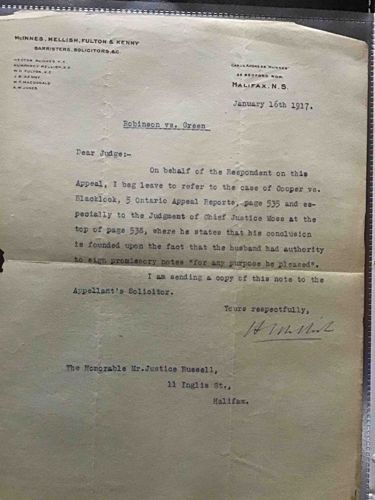
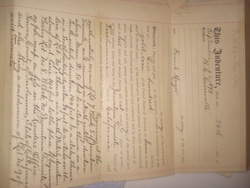
This item is an aged legal letter, typed on a piece of paper that appears to be off-white or cream-colored, suggesting its age. The paper exhibits significant signs of wear, including multiple creases and folds, particularly noticeable across the middle and top, which have resulted in discoloration and potential weakening of the paper fibers. The surface has a slightly mottled appearance, indicative of age and handling, with some areas appearing darker or lighter due to subtle staining or fading. The text is typed in a clear, consistent font, characteristic of early 20th-century typewriters. The letterhead at the top left reads "Mcnnes, Mellish, Fulton & Kenny Barristers, Solicitors, &C.," indicating the law firm that drafted the document. Below this, there are names of individuals, likely partners in the firm. On the top right, another header mentions "Halifax, N.S.," confirming the location, and the specific date "January 16th, 1917."
The content of the letter addresses a legal matter, specifically referencing a case "Robinson vs. Green" and discussing an appeal. It cites a previous case, "Cooper vs. Blacklook, 5 Ontario Appeal Reports, page 535," and a judgment by Chief Justice Moss. The letter is addressed to "Dear Judge-" and concludes with "Yours respectfully," followed by an illegible handwritten signature, presumably of one of the solicitors. Below the closing, the recipient is named as "The Honorable Mr. Justice Russell," with an address "11 Inglis St., Halifax." This detail helps to identify the recipient and the local context. The overall condition suggests that the document has been stored, possibly folded, for many years, leading to the visible creasing and slight darkening of the paper, consistent with natural aging processes. There are no obvious tears or repairs, but the document is brittle in appearance. The ink from the typewritten text remains largely clear, though some faintness may be observed in certain areas due to paper degradation or light exposure. This document is a direct insight into early 20th-century legal proceedings and practices in Halifax, Nova Scotia, offering historical value.
AI Appraisal Report
Upon examining the provided image of this 1917 legal correspondence from McInnes, Mellish, Fulton & Kenny, I assess its condition as fair to good for its age. The paper's off-white to cream hue, characteristic of early 20th-century paper, shows significant creasing and folding, particularly across the middle and top, which has led to localized discoloration and fiber weakening. The mottled appearance, consistent with age and handling, further supports this. The typewritten text remains largely clear, which is crucial for readability and historical integrity. The presence of the firm's letterhead, date, specific case names ("Robinson vs. Green"), legal citations, and the address to "The Honorable Mr. Justice Russell" at a verifiable Halifax address, strongly authenticate its period and origin.
From a market perspective, historical legal documents of this nature, especially those not directly connected to a major historical figure or event, typically have a niche but limited demand. Their value lies primarily in their historical insights rather than their inherent artistic or collectible rarity. Comparables often include similar dated business letters, legal transcripts, or minor historical ephemera from local Canadian contexts. These generally fetch modest prices unless they contain groundbreaking legal precedent or relate to a widely known incident or individual. This item offers a glimpse into local legal proceedings in Halifax, Nova Scotia, making it of interest to local history enthusiasts, legal historians, or institutions.
Key factors impacting value here include the good legibility despite condition issues and the clear dating and provenance within a specific legal firm and city. However, the lack of a prominent signature or direct involvement of a highly significant historical figure limits its broader appeal and higher valuation. Rarity is moderate; while a specific letter like this is unique, ephemera from this period from law firms are not exceptionally rare. Without physical examination, I cannot definitively ascertain paper brittleness, exact ink degradation, or the presence of subtle watermarks or hidden repairs. Full authentication would benefit from in-person inspection to assess paper quality, ink stability, and any physical alterations, as well as researching the firm and individuals mentioned for further provenance documentation. Scientific testing, such as paper fiber analysis or ink chromatography, would provide the most definitive authentication but is typically reserved for items of much higher potential value.
Given these considerations, I value this document based on its historical authenticity, content, and observable condition, balanced against its limited broader market appeal.