AI estimate as of July 19, 2025 · verify with a professional before acting
AI-Generated · Verify before acting
Everything on this page is generated by AI for informational purposes only. AI can make mistakes — the AI may misidentify items or misattribute them (artist, maker, brand, designer, origin, era). This is not an official valuation and should not be used for insurance, sale, tax, estate, legal, or lending purposes — or any decision requiring a certified appraisal. It is not an authoritative claim about any person, brand, or rights holder — do not share or rely on it as a factual statement about a third party. Always consult qualified professionals before making financial decisions.
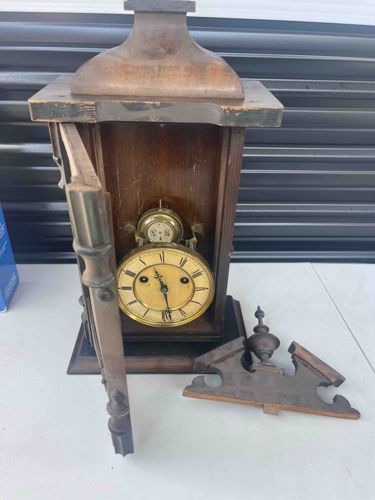
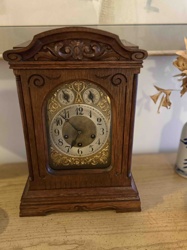
This appears to be an antique or vintage wall-mounted or shelf clock, likely a 'Vienna Regulator' style or similar pendulum clock, currently in a disassembled or damaged state. The main body of the clock is crafted from dark-stained wood, possibly oak or walnut, showing a discernible wood grain. The case is rectangular with a broader, projecting base and a shaped top section, perhaps a pediment or crown, that is also made of wood. On top of the main body, there's a separate, squarish wooden finial or decorative element, indicating it might originally have had a more elaborate top. The clock face is round, metallic (likely brass or gilded), with black Roman numerals and delicate black hands. Below the main clock face, there's a smaller dial, possibly for a seconds hand or a calendar function, though its details are obscured. The brass bezel around the main dial appears to be intact. Internally, brass clockwook components are visible above the main dial, suggesting a mechanical movement. Condition-wise, the item shows significant wear and damage consistent with age and probable neglect. The dark finish on the wood is worn and faded in many areas, particularly on edges and corners, revealing lighter wood underneath. There are visible scuffs, scratches, and nicks on the wooden surfaces. One significant wooden element, possibly a decorative side pillar or a bottom bracket, is completely detached and resting beside the main clock body. This piece has a carved or turned design, showing signs of breakage at its attachment points. Another broken wooden element, appearing to be a part of the base or a decorative foot, also lies detached, demonstrating intricate scrollwork and possessing a small, turned finial. The overall construction suggests late 19th or early 20th-century craftsmanship. The quality of the visible components, particularly the brass dial and movement parts, suggests a reasonably well-made piece, though its current state precludes a full assessment of its working condition or internal mechanisms.
AI Appraisal Report
Upon examining the provided image of this disassembled antique wooden wall/shelf clock, my assessment indicates it is consistent with late 19th or early 20th-century European mechanical pendulum clocks, likely a 'Vienna Regulator' style due to its general form, visible internal movement components, and dual dials. Authenticity, based solely on visual cues, appears strong for the period piece claims. The timber, possibly oak or walnut with a dark stain, aligns with materials used during that era. The brass dial with Roman numerals and the apparent brass movement components also support this period. The smaller dial suggests a seconds sub-dial, common for these regulators.
However, the current condition significantly impacts its value. The clock is clearly disassembled or severely damaged, with detached wooden elements including what appears to be a decorative side pillar and a part of the ornate base, exhibiting visible breakage. The worn and faded finish, scuffs, scratches, and nicks across the wooden surfaces indicate considerable neglect and wear consistent with age. This extensive damage necessitates significant restoration by a skilled conservator to regain functionality and aesthetic appeal. Without a physical inspection, I cannot confirm the completeness of all internal components, the extent of movement damage, or if any parts are missing. Furthermore, verification of the wood type (oak vs. walnut), and the exact nature of the brass (e.g., solid brass vs. plated) would require in-person examination. Provenance documentation, if available, would significantly enhance authentication and value. Without these, the value remains speculative.
Market conditions for non-functional, heavily damaged antique clocks are modest. While complete, functional Vienna Regulators in good condition can fetch higher prices, this piece, in its current state, is largely valued for its potential for restoration and as a project piece or for parts. Comparables for such damaged clocks typically trade hands at decorator prices for the case alone, or slightly more if the movement is salvageable. The detached, broken decorative elements further complicate restoration, requiring intricate work.
Demand for antique clocks remains steady among collectors, but the rarity of this specific, damaged piece is low given its condition. The significant repair costs required are a major limiting factor in its market value.