These notes were written by the person who submitted this item. Appraiser.AI has not verified them, and the AI's identification and estimate may rely on them.
AI Estimated Value
Not an official valuation
$400-600
AI estimate as of December 8, 2025 · verify with a professional before acting
AI-Generated · Verify before acting
Everything on this page is generated by AI for informational purposes only. AI can make mistakes — the AI may misidentify items or misattribute them (artist, maker, brand, designer, origin, era). This is not an official valuation and should not be used for insurance, sale, tax, estate, legal, or lending purposes — or any decision requiring a certified appraisal. It is not an authoritative claim about any person, brand, or rights holder — do not share or rely on it as a factual statement about a third party. Always consult qualified professionals before making financial decisions.
This analysis also relies on unverified notes provided by the user, which may be incomplete or inaccurate and could affect the result.
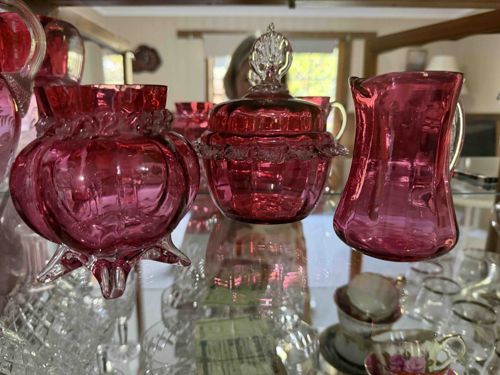
This collection features a set of three antique or vintage cranberry glass pieces, likely from the late 19th to early 20th century, due to their distinct color and decorative style. The set comprises a creamer, a footed sugar bowl with a lid, and a decorative footed bowl. All items are made from a rich, translucent cranberry-colored glass, exhibiting varying degrees of color saturation that suggests hand-blown or pressed techniques. Each piece features applied clear glass 'gummies' or 'prunts' around the rims, resembling small, blob-like adornments, which is a characteristic decorative element. The footed bowl has a bulbous, pumpkin-like body with a scalloped rim, resting on three clear glass feet. The sugar bowl is also globular, with a fitted lid topped by a clear glass finial, and an ornate clear glass handle on each side, though only one is clearly visible. This sugar bowl also features the clear glass gummies around its rim. The creamer is more simply shaped, with a flared rim and a clear glass handle. The glass itself is smooth and reflective, indicating good preservation of the surface. No significant chips, cracks, or repairs are immediately visible from the provided images, though a thorough inspection would be required to confirm this. The craftsmanship appears artisanal, with slight irregularities in the applied 'gummies' and overall form, characteristic of handcrafted glass of the period. These pieces are likely meant for decorative display or serving in a formal setting.
AI Appraisal Report
I have examined the provided images of this Cranberry Glass Tableware Set, which includes a creamer, a lidded sugar bowl, and a footed bowl. Based on the visual evidence, these pieces appear to be genuine antique or vintage cranberry glass, likely dating from the late 19th to early 20th century. The rich cranberry hue, the presence of applied clear glass 'gummies' or 'prunts', and the artisanal irregularities in form and application are consistent with hand-blown or pressed glass from that era. The 'gummies' are a notable decorative feature, adding to their authenticity and period charm.
Visually, the condition appears to be very good. I see no immediate signs of significant chips, cracks, or repairs, and the glass surface maintains a good reflective quality. This excellent preservation positively impacts value. However, without a physical examination, I cannot definitively confirm the absence of hairline cracks, fleabites, or professional repairs. A thorough in-person inspection would be essential to verify the true condition.
In terms of market conditions, cranberry glass, especially sets with decorative elements like applied prunts, generally retains a moderate to good demand among collectors of antique glassware. While not exceedingly rare, a well-preserved, complete set like this is more desirable than individual pieces. Current market trends for decorative antiques are stable, though not experiencing the strong growth seen in past decades. Comparable sales of similar cranberry glass items with applied decoration suggest values within the mid-hundreds range.
Factors impacting value positively are the apparent good condition and the completeness of the set with its distinctive 'gummies.' The primary limitation in full authentication and valuation is the lack of physical inspection. I cannot assess internal flaws, weight, glass thickness variations, or detect professional repairs that might be invisible in photographs. Provenance documentation, if available, could further enhance the value by confirming origin and history.