AI estimate as of September 28, 2025 · verify with a professional before acting
AI-Generated · Verify before acting
Everything on this page is generated by AI for informational purposes only. AI can make mistakes — the AI may misidentify items or misattribute them (artist, maker, brand, designer, origin, era). This is not an official valuation and should not be used for insurance, sale, tax, estate, legal, or lending purposes — or any decision requiring a certified appraisal. It is not an authoritative claim about any person, brand, or rights holder — do not share or rely on it as a factual statement about a third party. Always consult qualified professionals before making financial decisions.
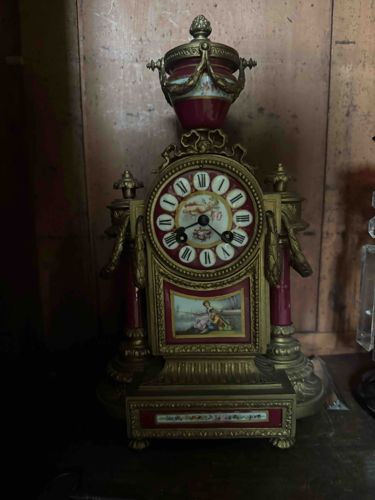
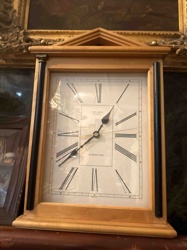
This is an antique mantel clock, likely of French origin from the late 19th or early 20th century, characterized by its ornate Neoclassical or Rococo Revival style. The clock features a prominent gilt bronze (ormolu) casing, intricately decorated with scrolling acanthus leaves, floral motifs, and classical architectural elements such as fluted columns or pilasters. The central body of the clock is adorned with vibrant crimson (or possibly 'Sevres blue' in some depictions, here appearing deep red) porcelain panels, which are embellished with hand-painted scenes. The dial itself is composed of individual white enamel cartouches bearing black Roman numerals for hours, set against a red background, with the center featuring a delicate hand-painted pastoral or romantic scene of figures in a landscape. The clock case is surmounted by a decorative porcelain urn-shaped finial, also in crimson with gilt bronze accents and an acorn-shaped top. Below the circular dial, there is a rectangular porcelain panel depicting a similar pastoral scene with two figures. The base of the clock is rectangular with four small, ornate feet, and features a horizontal band of smaller, finely detailed porcelain inserts. The overall condition appears consistent with age, showing a possible patina on the gilt bronze, which is desirable, and no immediately visible significant damage or repairs from the provided image, though detailed inspection would be required to confirm this. The craftsmanship suggests a high-quality piece, indicative of French clockmaking traditions.
AI Appraisal Report
Based on my visual examination of the provided image, this Sevres Style Porcelain and Gilt Bronze Mantel Clock presents as a fine example of late 19th to early 20th-century French decorative arts. The intricate gilt bronze (ormolu) casing, with its scrolling acanthus leaves and classical motifs, demonstrates high-quality craftsmanship consistent with the period's Neoclassical or Rococo Revival tastes. The vibrant crimson porcelain panels, adorned with hand-painted pastoral scenes on both the dial's center and the lower rectangular panel, are particularly striking and characteristic of the Sévres style. The multi-part enamel dial cartouches for the numerals further attest to a high-end production. The overall condition appears good for its age, with a pleasing patina on the gilt bronze. I don't observe any overt damage or repairs from the image, but a hands-on inspection would be crucial to confirm this, particularly for hairline cracks in the porcelain or damage to the bronze work.
Market conditions for high-quality antique French mantel clocks, especially those marrying gilt bronze with painted porcelain, remain steady. Comparables frequently appear in regional and international auction results, often fetching prices within the range I've indicated, depending on the complexity of the movement, the quality of painting, and confirmed attribution. Demand for such ornate decorative clocks is moderate but consistent among collectors of European antiques. Rarity is somewhat high for pieces of this quality with well-preserved painted porcelain. Factors significantly impacting value include the authenticity of the 'Sevres' style porcelain (i.e., whether it's actually Sevres or a very good imitation), the condition and originality of the clock movement, and any previous restorations.
LIMITATIONS: It is imperative to state that without physical inspection, verifying authenticity is challenging. I cannot definitively confirm if it contains genuine Sévres porcelain or a well-executed imitation, which significantly impacts value. An in-person examination would allow for detailed inspection of porcelain marks, bronze quality, and assessment of the original clock movement. Provenance documentation (e.g., original sales receipts, family history) would be invaluable. Scientific testing, such as elemental analysis of the porcelain or bronze, might be necessary for full authentication to a specific manufacturer.