AI estimate as of December 1, 2025 · verify with a professional before acting
AI-Generated · Verify before acting
Everything on this page is generated by AI for informational purposes only. AI can make mistakes — the AI may misidentify items or misattribute them (artist, maker, brand, designer, origin, era). This is not an official valuation and should not be used for insurance, sale, tax, estate, legal, or lending purposes — or any decision requiring a certified appraisal. It is not an authoritative claim about any person, brand, or rights holder — do not share or rely on it as a factual statement about a third party. Always consult qualified professionals before making financial decisions.
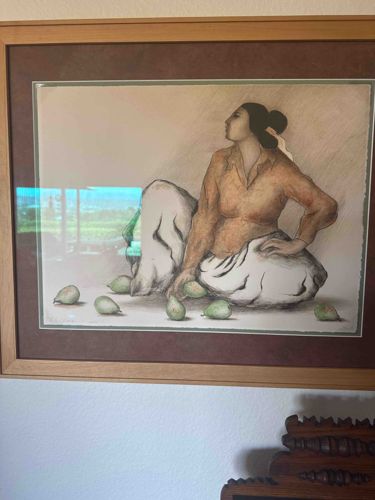
This item is a framed print depicting a seated woman on what appears to be a light-colored ground or floor, surrounded by several green pears. The woman is rendered in a naturalistic style with a slightly elongated, elegant form. She has dark hair tied back in a bun, with a lighter-colored ribbon or band visible in her hair. Her skin tone is a soft, muted brown. She wears an earth-toned, possibly ochre or sienna, collared shirt with long sleeves, and loose-fitting, light-colored trousers or skirt that gather around her. One hand is placed on her hip, while the other is obscured, possibly resting on the ground or a pear. Her gaze is directed upwards and to the right, suggesting contemplation or observation. The background is simple and unadorned, a plain light grey or beige wall. Approximately nine green pears are scattered around her, adding a touch of naturalistic detail and color contrast. The print is presented under clear glass within a simple, light-colored wooden frame with a visible grain, suggesting oak or a similar timber. The print is further matted with a dark, perhaps deep brown or burgundy, inner mat that outlines the artwork. The overall condition appears good, with no immediately visible tears, creases, or significant damage to the print itself. Reflections on the glass prevent a detailed inspection of potential foxing or fading, but the colors appear relatively vibrant. The framing itself seems sturdy and well-maintained. The style suggests a contemporary or modern aesthetic, possibly from the late 20th or early 21st century, with an emphasis on soft lines and a muted color palette. The craftsmanship of the framing appears to be of good commercial quality.
AI Appraisal Report
I have examined the provided image of this framed print depicting a seated woman with pears. Visually, the print appears to be in good condition, showing no obvious tears, creases, or significant damage. The colors seem relatively vibrant, suggesting either good preservation or a modern production. The framing, a simple light-colored wooden frame with a dark inner mat, appears sturdy and well-maintained, indicating good commercial quality craft. This clean presentation contributes positively to the item's perceived value.
Based on the naturalistic style, soft lines, and muted color palette, the print likely dates from the late 20th or early 21st century. While aesthetically pleasing, the artistic style does not immediately suggest a well-known or highly collectible artist, which would typically command higher prices. The market for decorative prints of this nature is generally steady, with value largely driven by aesthetic appeal and condition rather than rarity or specific artist provenance. Comparable prints by unlisted or lesser-known artists in similar commercial framing typically sell in the $100-$300 range, depending on size and specific visual appeal.
Demand for this type of decorative artwork is moderate; it would appeal to buyers seeking contemporary or modern art for home or office decor. Rarity is not a significant factor here, as most prints of this style are produced in open or large limited editions. The primary factors influencing value are the appealing subject matter, good overall condition, and adequate framing.
It is crucial to note the limitations of this appraisal without physical inspection. I cannot definitively assess the print's authenticity (i.e., whether it's an original print or a reproduction, though the description implies a print) or full condition. An in-person examination would be required to check for foxing, fading, or damage beneath the mat, and to confirm the printmaking technique. Authentication would also necessitate a signature by the artist (if applicable) and any provenance documentation or scientific testing to determine the specific printing process and edition details, none of which are discernible from the image alone.