AI estimate as of September 5, 2025 · verify with a professional before acting
AI-Generated · Verify before acting
Everything on this page is generated by AI for informational purposes only. AI can make mistakes — the AI may misidentify items or misattribute them (artist, maker, brand, designer, origin, era). This is not an official valuation and should not be used for insurance, sale, tax, estate, legal, or lending purposes — or any decision requiring a certified appraisal. It is not an authoritative claim about any person, brand, or rights holder — do not share or rely on it as a factual statement about a third party. Always consult qualified professionals before making financial decisions.
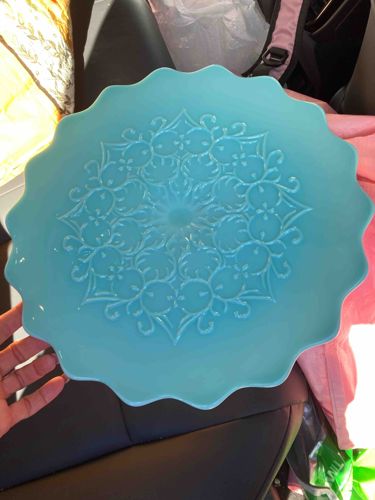
This item is a decorative plate, likely made of ceramic, porcelain, or possibly glass, distinguishable by its vibrant turquoise or light teal color with a glossy finish. The plate features a distinctive scalloped or wavy edge, contributing to its ornamental aesthetic. The most prominent feature is the intricate, raised floral or botanical pattern embossed on the surface of the plate. This design forms a circular medallion in the center, radiating outwards with detailed scrollwork and stylized floral elements. The embossing appears to be the same color as the plate, creating a subtle, textural contrast rather than a color contrast. The craftsmanship suggests a molded or pressed technique to achieve the raised pattern. While no visible chips, cracks, or significant wear are discernible from the image, the finish appears smooth and intact. The exact size is not provided, but given the hand visible in the image, it appears to be of a medium size, suitable for serving small pastries, displaying, or as part of a table setting. There are no obvious maker's marks or signatures visible, suggesting it might be a mass-produced item rather than a unique artisan piece. The style appears to be contemporary or possibly mid-20th century, leaning towards a decorative rather than purely utilitarian purpose. The overall quality seems good, with a consistent color and well-defined embossed pattern.
AI Appraisal Report
Upon visual examination of the provided image, I note this decorative plate's vibrant turquoise color, scalloped edge, and intricate raised floral embossing. The finish appears glossy and uniform, with no discernible chips, cracks, or significant wear, suggesting good overall condition. The embossed pattern hints at a molded or pressed manufacturing technique, which is typical for mass-produced decorative ceramics or glass.
Authenticity, based solely on this image, points to a contemporary or mid-20th-century decorative piece. The lack of visible maker's marks or signatures prevents identification of origin, manufacturer, or designer. This significantly limits any claim to high-end artistry or collectability.
Market conditions for similar decorative plates are generally modest. Comparables in online marketplaces and antique shops typically range from $10 to $50, depending on condition, size, and specific aesthetic appeal. While visually appealing, this item does not present as rare; its design seems consistent with decorative mass production.
Factors impacting value include its good condition and pleasing aesthetic. However, the absence of provenance, maker's marks, or any indication of being a unique artisan piece severely limits its value. Demand for generic decorative plates is stable but not particularly high, largely driven by interior decor trends rather than serious collecting.
Limitations in authenticity verification from images alone are profound. Without physical inspection, I cannot confirm the material (ceramic, porcelain, glass), assess true texture, weight, or detect subtle imperfections missed by the camera. In-person examination would be required to search for hidden maker's marks, assess the true quality of the glaze, and confirm the method of manufacture. Provenance documentation, such as sales receipts or historical records, would be essential to establish any significant history or verify a reputable origin, which could elevate its value. Scientific testing, like material analysis, would be necessary for definitive material identification if ambiguity exists.