These notes were written by the person who submitted this item. Appraiser.AI has not verified them, and the AI's identification and estimate may rely on them.
AI Estimated Value
Not an official valuation
$650
AI estimate as of June 28, 2025 · verify with a professional before acting
AI-Generated · Verify before acting
Everything on this page is generated by AI for informational purposes only. AI can make mistakes — the AI may misidentify items or misattribute them (artist, maker, brand, designer, origin, era). This is not an official valuation and should not be used for insurance, sale, tax, estate, legal, or lending purposes — or any decision requiring a certified appraisal. It is not an authoritative claim about any person, brand, or rights holder — do not share or rely on it as a factual statement about a third party. Always consult qualified professionals before making financial decisions.
This analysis also relies on unverified notes provided by the user, which may be incomplete or inaccurate and could affect the result.
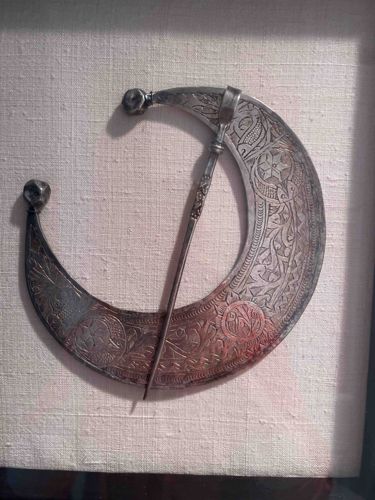
This piece is a striking handcrafted crescent-shaped brooch, likely composed of silver as indicated by the context, exhibiting a substantial and robust construction. The brooch features a broad, curved body terminating in two distinct spherical or bulbous finials. A long, slender pin extends from one finial, passing through a tightly fitted, movable ring-slide on the crescent body, and then secures by resting against the opposite terminal, forming a functional penannular closure typical of ancient and historical fibulae. The entire surface of the crescent body is densely adorned with intricate repoussé or chased decorative patterns. These highly detailed engravings predominantly feature complex interlace knotwork, swirling curvilinear motifs, and what appear to be stylized zoomorphic figures, possibly birds or serpents, integrated within the flowing designs. Several prominent circular medallions punctuate the broader areas of the crescent, each containing detailed internal patterns, including what looks like a stylized star or floral element in one section. The pin itself is also embellished with fine engraved details near its head, showcasing additional craftsmanship. Visually, the design aesthetic strongly recalls Celtic Revival, Viking Age, or possibly Art Nouveau ornamentation, characterized by organic forms and continuous, flowing lines. Despite its stylistic echoes, the provided context suggests its manufacture in Laos around 1950, which would classify it as a mid-20th century piece, potentially a revivalist or tourist art item inspired by these older traditions. The metal displays a rich, dark patina, particularly in the recessed areas of the engraving, which enhances the intricate details and attests to its age. There are no readily apparent signs of significant damage, breaks, or repairs; the piece appears to be in very good condition with wear consistent with its age and use. The craftsmanship, evident in the precision of the engraving and the careful shaping of the form, indicates a high degree of skill. Its substantial size and detailed ornamentation suggest it was a prominent piece of personal adornment.
AI Appraisal Report
Upon virtual examination of the provided images and descriptions, I assess this handcrafted crescent-shaped fibula or brooch to be in very good condition, consistent with a mid-20th century piece. The metal exhibits a rich, dark patina, particularly accentuating the intricate repoussé or chased patterns. I observe no significant damage, breaks, or repairs; wear appears appropriate for its age.
The craftsmanship is exemplary, showcasing a high degree of skill in the detailed interlace knotwork, curvilinear motifs, and zoomorphic figures. Its substantial size and intricate ornamentation suggest it was a prominent piece of adornment. While stylistically recalling Celtic Revival, Viking, or Art Nouveau influences, the provided context of a 1950 Laotian origin suggests it is a well-executed piece of revivalist or tourist art from that region, which adds to its unique character.
Market demand for well-crafted vintage ethnic or revivalist silver jewelry is stable. Its value is driven by its presumed silver content, exceptional handcraftsmanship, very good condition, and distinctive design. While specific comparables for 1950s Laotian fibulae with these distinct stylistic elements are rare, similar quality handcrafted vintage silver brooches would inform its value.
A crucial limitation in this appraisal is the absence of an in-person examination. To fully verify authenticity and establish a definitive value, I recommend XRF testing to confirm silver purity and content, examination for maker's marks or hallmarks, precise measurements and weight, and a detailed physical inspection of its construction techniques. Further provenance documentation and clarification on whether it's a standalone brooch or a component of a larger "marriage necklace" (as per the owner's note, which is contrary to the visual cues of a brooch) would also significantly enhance valuation accuracy. Without these, this appraisal is based purely on visual evidence and provided data.