These notes were written by the person who submitted this item. Appraiser.AI has not verified them, and the AI's identification and estimate may rely on them.
AI Estimated Value
Not an official valuation
$30-50
AI estimate as of July 30, 2025 · verify with a professional before acting
AI-Generated · Verify before acting
Everything on this page is generated by AI for informational purposes only. AI can make mistakes — the AI may misidentify items or misattribute them (artist, maker, brand, designer, origin, era). This is not an official valuation and should not be used for insurance, sale, tax, estate, legal, or lending purposes — or any decision requiring a certified appraisal. It is not an authoritative claim about any person, brand, or rights holder — do not share or rely on it as a factual statement about a third party. Always consult qualified professionals before making financial decisions.
This analysis also relies on unverified notes provided by the user, which may be incomplete or inaccurate and could affect the result.
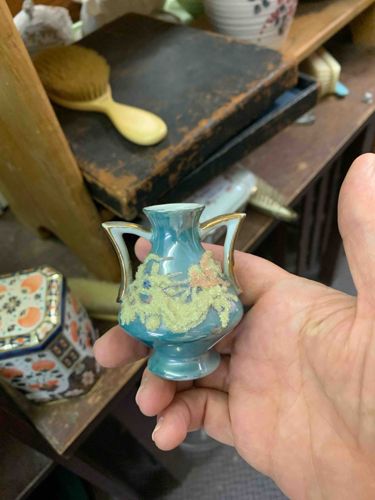
This is a small, ornate, handled vase, likely ceramic or porcelain, characterized by a lustrous, iridescent teal or turquoise glaze. The vase is miniature in scale, comfortably held within the palm of a hand, suggesting it is a decorative accessory rather than a functional vessel for large floral arrangements. Its form features a flared mouth and foot, with a bulbous body that tapers slightly towards the bottom. Two delicate handles, possibly gilded, gracefully extend from the rim to the upper body, adding to its elegant aesthetic. The surface is adorned with raised, textured decoration, predominantly in a light green or pale yellow hue, depicting what appears to be floral or foliate motifs, possibly with touches of orange or peach, creating visual depth and contrast against the shiny blue background. The textured design suggests a moriage technique, where slip is applied thickly to create a raised, tactile surface. Given the 'Made in Japan' context, this piece could be an example of Satsuma ware or a similar Japanese ceramic tradition from the late 19th to early 20th century, which often incorporated detailed, hand-painted and textured elements with rich glazes. The overall condition appears to be relatively good, with no obvious chips or cracks visible from the provided image, though the full extent of wear, particularly to the gilded handles or the raised decoration, cannot be fully assessed. The craftsmanship suggests a hand-finished item, valued for its intricate detailing and decorative appeal.
AI Appraisal Report
Upon examining the images of this miniature Japanese handled vase, my assessment is that it represents a fine example of early 20th-century Japanese decorative arts, likely produced for the export market. The piece features a vibrant iridescent teal glaze and intricate moriage slipwork, a technique involving the application of raised enamel decorations. The floral motifs and delicate gilded handles are characteristic of this period, often associated with, but not limited to, Satsuma-style wares. Based on the visual evidence, the vase appears to be in good condition, with no immediately apparent chips or cracks. The "Made in Japan" mark typically dates it to the period between 1921 and the 1940s.
The market for such decorative pieces is stable, with consistent demand among collectors of Japanese ceramics. Comparable moriage vases of this miniature size and quality typically sell in the $25 to $65 range at auction and online marketplaces. The value is primarily driven by its decorative appeal and condition rather than significant rarity. The iridescent glaze is a particularly attractive feature that could enhance its desirability.
It is crucial to note the limitations of an appraisal based solely on images. A full, in-person examination would be necessary to confirm the absence of hairline cracks, repairs, or wear to the gilding and moriage, any of which would negatively impact value. definitive attribution to a specific kiln or maker would require inspecting the base for specific marks beyond the general country-of-origin stamp.