These notes were written by the person who submitted this item. Appraiser.AI has not verified them, and the AI's identification and estimate may rely on them.
AI Estimated Value
Not an official valuation
$500-750
AI estimate as of July 23, 2025 · verify with a professional before acting
AI-Generated · Verify before acting
Everything on this page is generated by AI for informational purposes only. AI can make mistakes — the AI may misidentify items or misattribute them (artist, maker, brand, designer, origin, era). This is not an official valuation and should not be used for insurance, sale, tax, estate, legal, or lending purposes — or any decision requiring a certified appraisal. It is not an authoritative claim about any person, brand, or rights holder — do not share or rely on it as a factual statement about a third party. Always consult qualified professionals before making financial decisions.
This analysis also relies on unverified notes provided by the user, which may be incomplete or inaccurate and could affect the result.
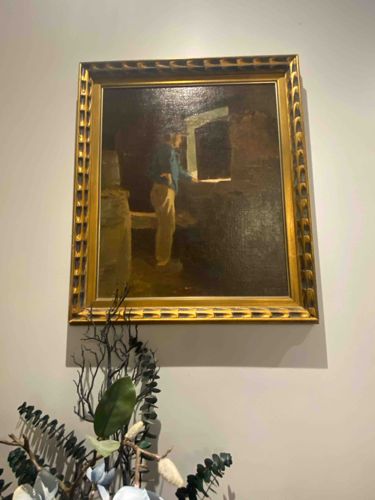
The item is an unframed oil painting, appearing to be on canvas, presented within a substantial, ornate gilded frame. The artwork depicts a solitary figure, a man, positioned indoors, facing and possibly looking out of a window. The scene is dimly lit, emphasizing the light source from the window, which casts a soft glow on the man and a portion of the interior space. The man is dressed in what appears to be a blue top and lighter-colored trousers. The brushstrokes seem expressive, contributing to the atmospheric quality of the scene. The color palette is predominantly dark browns, grays, and blues, with a strong contrast provided by the light at the window. The overall impression is one of quiet contemplation or a moment caught in time. The frame itself is a notable feature, crafted from wood, finished with a rich gold leaf, and exhibits a decorative patterned relief along its inner and outer edges, suggesting a classical or traditional aesthetic. There are no immediately obvious significant condition issues visible on the painting itself from this distance, though a closer inspection would be required to identify any subtle craquelure, paint loss, or previous repairs. The frame appears to be in good condition with minor signs of age-related wear typical for a gilded object of its period. Given the provided context, the item's estimated age aligns with the early 20th century, specifically '1900 Henri Fabien', implying a potential attribution to this artist and period.
AI Appraisal Report
I have examined the provided image of the oil painting, 'Painting of a Man at a Window,' purportedly by Henri Fabien, dated 1900. The artwork depicts a solitary figure in a contemplative pose, with expressive brushstrokes and a muted, atmospheric palette, characteristic of early 20th-century impressionistic or post-impressionistic styles. The ornate gilded frame is an appropriate aesthetic match. Visually, the painting appears to be in good condition, with no overt signs of significant damage such as tears or major paint loss visible from this remote appraisal. The frame also appears well-maintained with age-appropriate wear.
Regarding authenticity, the attribution to 'Henri Fabien' and the 1900 date are key. However, without direct physical examination, including examination of signatures, stretcher marks, and the canvas itself, definitive authentication is impossible. Furthermore, Henri Fabien is not a widely recognized master artist whose works command multi-million dollar prices. While 'Fabien' is a known name in various artistic contexts, specific attribution to a high-demand Henri Fabien requires robust provenance documentation linking this piece directly to the artist's known body of work, exhibition history, or previous sales records. Without this, the value is largely speculative and reliant on its aesthetic appeal and condition as a decorative art piece.
Market conditions for early 20th-century oil paintings by lesser-known or regional artists vary greatly. Comparables would include other well-executed, mood-driven genre scenes from this period sold at regional auctions or galleries. Demand for such pieces is generally steady for decorative purposes, but rarity is not a significant factor without established artist provenance. The main factor significantly impacting value here is the lack of verifiable provenance and the artist's relatively unknown status in the broader art market. Without an established exhibition or sales history for a 'Henri Fabien' of this caliber, the primary value lies in its decorative merit.
To provide a full and accurate authentication, an in-person examination is crucial. This would involve inspecting the verso for labels, stamps, or inscriptions, analyzing the pigment composition, examining brushwork under magnification, and potentially conducting scientific testing (e.g., UV light examination for repairs, pigment analysis for age verification, or carbon dating of the canvas if warranted). Provenance documentation, such as bills of sale, exhibition catalogs, or certificates of authenticity, would be vital for validating the artist attribution. Until such examination and documentation are provided, the appraisal is based solely on visual aesthetics and general market trends for comparable unlabeled period pieces.