These notes were written by the person who submitted this item. Appraiser.AI has not verified them, and the AI's identification and estimate may rely on them.
AI Estimated Value
Not an official valuation
$25 - $45
AI estimate as of July 12, 2025 · verify with a professional before acting
AI-Generated · Verify before acting
Everything on this page is generated by AI for informational purposes only. AI can make mistakes — the AI may misidentify items or misattribute them (artist, maker, brand, designer, origin, era). This is not an official valuation and should not be used for insurance, sale, tax, estate, legal, or lending purposes — or any decision requiring a certified appraisal. It is not an authoritative claim about any person, brand, or rights holder — do not share or rely on it as a factual statement about a third party. Always consult qualified professionals before making financial decisions.
This analysis also relies on unverified notes provided by the user, which may be incomplete or inaccurate and could affect the result.
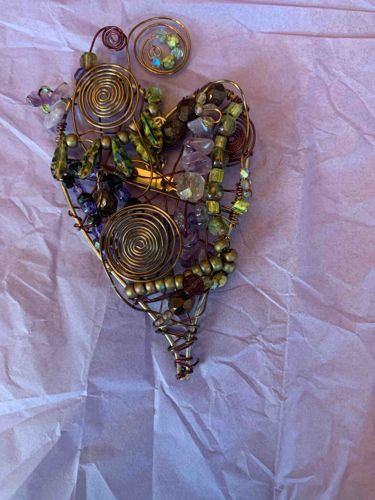
This is a handcrafted wire and bead heart-shaped brooch, likely a one-of-a-kind artisan piece. The primary structure is formed from a thick, golden-hued wire, shaped into a stylized heart silhouette. This main wire framework is adorned with thinner, possibly copper-colored wire, intricately wrapped and coiled around the base and throughout the interior, creating a delicate, cage-like effect. Within this wire framework, a variety of beads are incorporated, demonstrating a rustic and organic aesthetic. The bead assortment includes faceted and tumbled amethyst or quartz pieces in varying shades of purple and clear, alongside numerous green beads of different shapes and sizes, some spherical, some elongated, and some with a mottled or swirled pattern. There are also smaller, metallic-gold colored spherical beads. Two prominent spirals made of the thicker golden wire are noticeable, one in the upper left curve of the heart and another near the bottom. A smaller, separate spiral element, also made of golden wire and containing a few small, iridescent beads, is affixed to the top left of the heart, adding a whimsical touch. The craftsmanship appears to be folk art or hobbyist level, with evidence of hand manipulation of the wire and natural variations in bead placement. There are no visible maker's marks or signatures, suggesting it is a unique, unsigned piece. The condition appears good, with no obvious signs of breakage or missing components, though the wires show a slight patina consistent with age and exposure, enhancing its vintage appearance. The pin mechanism, characteristic of a brooch, would be located on the reverse side, though it is not visible in the provided image. The overall design suggests a contemporary artisan period, likely post-2000, given the 'bohemian' or 'naturalist' jewelry trend.
AI Appraisal Report
Upon visual examination, this item is a handcrafted Artisan Wire and Bead Heart Brooch. The piece is constructed from a non-precious, gold-toned wire base, intricately wrapped with a thinner, possibly copper wire, and embellished with a variety of beads, including what appears to be amethyst or quartz and various glass or stone beads. The craftsmanship is consistent with that of a skilled hobbyist or artisan rather than a high-end jewelry house. The condition appears to be good, with a slight patina that adds to its rustic charm. Given the materials and construction, this piece falls into the category of artisan or folk art jewelry. The primary value drivers are its unique, one-of-a-kind design and aesthetic appeal rather than the intrinsic value of its components.
The market for unsigned artisan jewelry is active on platforms like Etsy and at craft fairs. Comparables are typically other wire-wrapped pieces with semi-precious stones. The demand is moderate, appealing to collectors of unique, bohemian-style accessories. The lack of a signature or maker's mark limits its value, as it cannot be attributed to a known or collected artist. A key factor limiting the appraisal is the inability to test the materials via image alone. A physical examination would be necessary to identify the metals (e.g., gold-filled, brass, copper) and to test the stones to confirm if they are amethyst, quartz, or glass. Without this verification, the appraisal assumes non-precious metals and semi-precious or glass beads.