AI estimate as of July 31, 2025 · verify with a professional before acting
AI-Generated · Verify before acting
Everything on this page is generated by AI for informational purposes only. AI can make mistakes — the AI may misidentify items or misattribute them (artist, maker, brand, designer, origin, era). This is not an official valuation and should not be used for insurance, sale, tax, estate, legal, or lending purposes — or any decision requiring a certified appraisal. It is not an authoritative claim about any person, brand, or rights holder — do not share or rely on it as a factual statement about a third party. Always consult qualified professionals before making financial decisions.
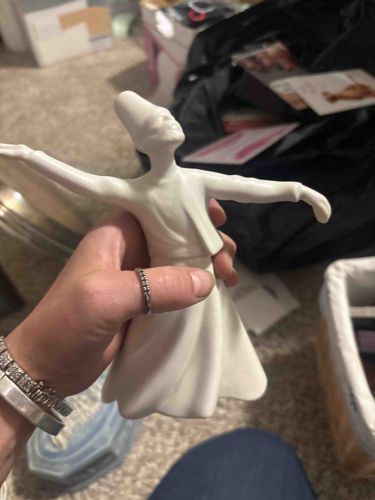
This appears to be a porcelain or ceramic figurine depicting a Mevlevi Dervish, commonly known as a Whirling Dervish. The figure is rendered in a solid, matte white finish, suggesting unglazed bisque porcelain or a similar ceramic material. It is a single, molded piece, with no visible seams or joins, indicating good craftsmanship. The figure is in a dynamic pose, characteristic of the Sema ritual, with arms outstretched, one palm facing upwards and the other downwards, symbolizing receiving from God and giving to humanity. The head is tilted slightly upwards, and the features of the face are subtly defined, conveying a sense of spiritual contemplation or ecstasy. The figure wears the distinctive attire of a Dervish, including the tall, conical felt hat known as a 'sikke' and a flowing robe (tennure) which appears to billow slightly at the base, although the full extent of the skirt isn't perfectly clear from the image. The folds and draping of the clothing are well-sculpted, adding to the sense of movement. There are no obvious signs of chips, cracks, or repairs visible in the provided image. The overall condition appears to be excellent, with a clean and uniform white surface. No maker's marks, signatures, or specific manufacturing details are discernible in the image. Based on its style and material, it likely dates from the mid-to-late 20th century or possibly early 21st century. The simplicity of color and form highlights the religious and cultural significance of the subject, making it an elegant and contemplative decorative piece.
AI Appraisal Report
Upon visual examination, this Whirling Dervish figurine presents as a well-crafted decorative piece, likely made from unglazed bisque porcelain or a similar ceramic material. Its condition appears excellent, with a clean, uniform matte white finish and no discernible chips, cracks, or repairs. The minimalist style, focusing on the dynamic form of the Sema dance, suggests a mid-to-late 20th or early 21st-century production date.
The primary factor influencing its value is that it appears to be a decorative item rather than a fine art sculpture by a known artist or a rare antique. The market for such figurines is generally accessible. Comparable modern, unsigned ceramic or porcelain Dervish figures of similar size and quality are widely available and typically sell in the lower range of the decorative arts market. While the subject is culturally significant and aesthetically pleasing, the lack of a known maker or studio mark significantly limits its value to collectors.
It is crucial to note the limitations of this appraisal. Without a physical inspection, I cannot confirm the material composition, check for a maker's mark on the underside, or identify any hairline cracks or restorations not visible in the image. Full authentication would require an in-person examination to search for signatures or stamps (e.g., from Turkish manufacturers like Kütahya or Iznik, or European studios). Provenance documentation would be necessary to attribute it to a specific artist or period, which could substantially alter its value.