AI estimate as of July 6, 2025 · verify with a professional before acting
AI-Generated · Verify before acting
Everything on this page is generated by AI for informational purposes only. AI can make mistakes — the AI may misidentify items or misattribute them (artist, maker, brand, designer, origin, era). This is not an official valuation and should not be used for insurance, sale, tax, estate, legal, or lending purposes — or any decision requiring a certified appraisal. It is not an authoritative claim about any person, brand, or rights holder — do not share or rely on it as a factual statement about a third party. Always consult qualified professionals before making financial decisions.
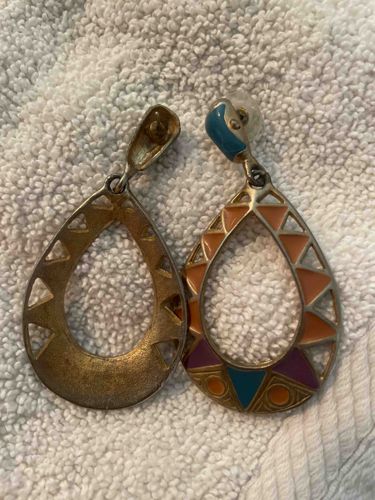
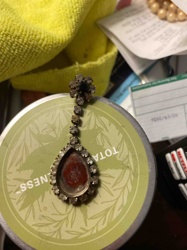
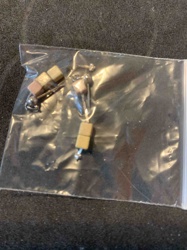
This item consists of a pair of drop earrings, distinct in their design and condition, featuring a teardrop or pear-shaped form. One earring appears to be the reverse side or an unfinished piece, showing a tarnished, slightly rough metallic surface, possibly bronze or a brass-like alloy, with a cutout pattern of small triangles along its outer edge, creating a textured border. The other earring, presumably the front or finished piece, displays vibrant enamel work within the same teardrop shape. This finished earring features geometric patterns, primarily triangles, filled with a palette of warm and cool tones, including light orange, purple, and a prominent turquoise or teal. Small circular motifs in orange are also visible near the bottom of this enameled piece.
Both earrings appear to be of similar size and construction, with a metallic base. The bails or ear wire attachments for securing them to the ear are simple, post-style findings, with one showing a blue enamel accent. There is visible wear and patina on the un-enameled earring, indicative of age or prolonged exposure, exhibiting an aged bronze or antiqued gold finish. The enameled earring shows its colors clearly, suggesting less wear on its decorated surface, though the metal base of this earring also appears to have some patina consistent with age. There are no discernible maker's marks or signatures visible from the provided images. The style suggests a possible vintage contemporary period, perhaps mid-to-late 20th century, with an aesthetic that could be influenced by Southwestern, Art Deco, or ethnic designs given its geometric motifs and color choices. The craftsmanship on the enameled piece appears neat, with clean lines separating the color segments, while the backend piece shows a more utilitarian finish. The discrepancy in appearance between the two pieces (finished vs. unfinished/reverse) is a unique characteristic.
AI Appraisal Report
Upon examining the provided images, I assess this pair of geometric enamel drop earrings, one finished with vibrant enamel and the other possibly a reverse side or unfinished piece. The enameled earring exhibits good condition, with clear, unchipped enamel in warm and cool geometric patterns. The un-enameled earring shows significant patina and minor surface irregularities consistent with age, suggesting a bronze or brass alloy. The disparity in finish between the two pieces is unusual but appears to be an intended design or a characteristic of how these pieces were constructed, rather than damage. Authenticity, based solely on visual examination, suggests they are indeed vintage, likely mid-to-late 20th century, given the stylistic queues, geometric motifs, and color palette. No maker's marks are visible, which is common for artisan or smaller-batch jewelry of this period.
Market conditions for vintage costume jewelry, especially unique, handcrafted pieces, remain steady. Comparables would include other vintage enamel or artisan-made earrings from the same era, often found in antique malls or online vintage marketplaces. Demand for such unique, wearable art pieces is consistent, particularly for those with a distinctive aesthetic like these, which could appeal to collectors of Southwestern, Art Deco, or ethnic-inspired jewelry. Rarity is moderate; while not a one-of-a-kind museum piece, the specific design and juxtaposition of finishes make them less common than mass-produced items.
Factors impacting value include the unique design, the good condition of the enameled surface, and the aged patina of the metallic components, which adds character. The absence of maker's marks, however, prevents attribution to a specific designer or studio, thereby limiting a premium based on provenance.
Limitations in authenticity verification from images alone are significant. A hands-on examination would allow for definitive identification of the metal composition, verification of the enamel type, and closer inspection for any hidden marks or repairs. Provenance documentation, if available, would significantly enhance value, and scientific testing could confirm material composition and age precisely. Without these, the appraisal relies heavily on visual inference and general market trends for similar items.