AI estimate as of August 2, 2025 · verify with a professional before acting
AI-Generated · Verify before acting
Everything on this page is generated by AI for informational purposes only. AI can make mistakes — the AI may misidentify items or misattribute them (artist, maker, brand, designer, origin, era). This is not an official valuation and should not be used for insurance, sale, tax, estate, legal, or lending purposes — or any decision requiring a certified appraisal. It is not an authoritative claim about any person, brand, or rights holder — do not share or rely on it as a factual statement about a third party. Always consult qualified professionals before making financial decisions.
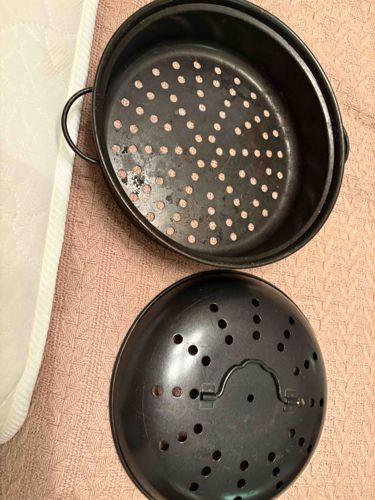
The item is a vintage or antique black-enameled metal canning or steaming rack, likely made of tin or steel with an enameled coating for rust resistance and ease of cleaning. It consists of two primary components: a tall, cylindrical pot or insert with a flat bottom and two loop handles on opposite sides, and a round, domed lid or separate insert with numerous perforations. The main pot or insert features a perforated bottom, indicating its function as a strainer or a rack for holding jars or food items above liquid. The perforations are uniform in size and evenly spaced across the entire bottom surface, allowing for efficient drainage or steam circulation. The interior surface shows some wear, with areas where the black enamel coating appears abraded or chipped, revealing the lighter metal underneath. There are also visible scuff marks and a light layer of dust or residue, consistent with moderate use and age. The exterior of this main component, particularly around the rim and handles, appears to retain more of its original finish. The separate domed component also has many circular perforations, but they are less uniformly distributed than those on the main insert's base. This piece also features a distinctive, hinged, and curved handle or mechanism in the center, designed to allow it to be lifted or perhaps to secure items within the pot. This handle appears to be part of an integrated, possibly collapsible, design. The overall construction suggests a utilitarian purpose, likely for canning fruits and vegetables, steaming large quantities of food, or possibly blanching. The black enamel finish, a common characteristic of kitchenware from the early to mid-20th century, points to an estimated age anywhere from the 1930s to the 1960s. The handles on both pieces are simple and functional, typical of industrial-style kitchen equipment. The slight imperfections in the enamel and the general wear suggest a well-used but sturdy piece of kitchen equipment.
AI Appraisal Report
Upon visual examination of the provided image, this Vintage Black Enameled Canning / Steaming Rack presents as a functional and authentic piece of early to mid-20th-century kitchenware. The black enameled finish, wear patterns, and utilitarian design are consistent with items produced for home canning or large-batch food preparation during the 1930s-1960s. The interior enamel abrasion and chipping, along with scuff marks, indicate moderate use but do not compromise its fundamental integrity for display or light functional use. Authenticity is supported by the typical construction methods and materials of the era; however, without physical inspection, I cannot confirm the exact metal composition or rule out modern reproductions attempting to mimic antique wear. In-person examination would allow for tactile assessment of the enamel's texture, weight, and a more precise evaluation of metal fatigue or hidden damage. Checking for manufacturer's marks or patents would also require physical access. Market conditions for vintage kitchenware of this type are generally stable, with demand driven by collectors of enamelware, home canning enthusiasts seeking period-appropriate tools, or those looking for decorative pieces with a rustic aesthetic. While not exceptionally rare, complete sets in this condition have some desirability. The primary factors impacting value include its good, albeit used, condition, and its functional completeness. The minor chips are common for enameled items of this age and do not significantly detract from value unless severe. Without physical inspection, precise authentication of the enamel's original application vs. any potential modern repair cannot be guaranteed, nor can the absence of lead in the enamel, which would be relevant if intended for food use today. Provenance documentation, if available, would enhance authentication and value, but none was provided.