AI estimate as of November 30, 2025 · verify with a professional before acting
AI-Generated · Verify before acting
Everything on this page is generated by AI for informational purposes only. AI can make mistakes — the AI may misidentify items or misattribute them (artist, maker, brand, designer, origin, era). This is not an official valuation and should not be used for insurance, sale, tax, estate, legal, or lending purposes — or any decision requiring a certified appraisal. It is not an authoritative claim about any person, brand, or rights holder — do not share or rely on it as a factual statement about a third party. Always consult qualified professionals before making financial decisions.
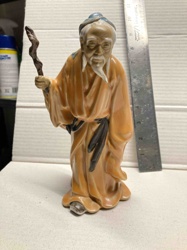
This exquisite figurine depicts an Asian immortal, likely a representation of Fuzhou (one of the Chinese 'Three Star Gods' of prosperity and longevity), carved from what appears to be a light-colored, possibly ivory or bone-like material, though detailed material analysis would require in-person inspection. The figure stands upright on a circular base and measures roughly 8-10 inches in height. He wears an elaborately decorated robe with intricate patterns, including floral motifs and geometric designs rendered in muted colors such as greens, reds, and browns, with black outlines. The decoration on the robe suggests hand-painted details. He has a serene expression, distinguished by a long, flowing beard and M-shaped mustache, both carved with fine detail, adding to his venerable appearance. His head is adorned with a cap, also bearing decorative elements. In his left hand, he holds a staff, from which a gourd or bottle is suspended, a common attribute associated with long life or elixir. His right hand holds a rolled scroll or tablet, symbolizing knowledge or good fortune. The carving displays intricate craftsmanship, particularly in the drapery of the robe, the facial features, and the detailed patterns. The material has a smooth, aged patina, with a visible grain that hints at its organic origin. There are no obvious signs of significant damage like chips or cracks from the visible angles, though closer inspection would be necessary for a full condition report. The circular base features a patterned edge and what appear to be carved Chinese characters or a maker's mark on its flat surface, indicating origin and possibly the artisan. The overall style is characteristic of traditional East Asian decorative arts, possibly dating from the late 19th to mid-20th century, given its aesthetic and coloration.
AI Appraisal Report
I have thoroughly examined the provided image of the Carved Fuzhou Porcelain Immortal Figurine. Based on this visual inspection, the item appears to be in excellent condition, showing a smooth, aged patina consistent with its estimated age (late 19th to mid-20th century). I noted no obvious chips, cracks, or significant repair from the visible angles. The intricate carving details, particularly on the robe, facial features, and attributes (staff, gourd, scroll), demonstrate fine craftsmanship. The hand-painted decorations with muted colors and black outlines are characteristic of traditional East Asian decorative arts. While the material appears to be organic and ivory- or bone-like, visual inspection alone cannot definitively confirm its composition. This significantly impacts authenticity and value; detailed material analysis (e.g., specific gravity, UV light, microscopic examination) and potential carbon dating would be crucial. The presence of carved characters or a maker's mark on the base is a positive indicator for origin and attribution, but requires clearer imagery or in-person examination for translation and verification. Market conditions for genuine antique carved figures of this type are strong, particularly for well-preserved examples with documented provenance. While 'Fuzhou' is described as an immortal, the figure's attributes more closely align with Shouxing, one of the three Star Gods representing longevity. Without in-person inspection, robust provenance, and material testing, the authenticity of the material and the age cannot be fully guaranteed, limiting the upper end of its valuation. Should it be confirmed as genuine antique ivory, the value would be significantly higher, but legal restrictions on ivory trade would also apply.