AI Appraisal Estimate

AI-generated estimates · not official valuations

From the user

What was submitted

Photo and notes provided by the user — not generated by AI

Submitted item photo
Submitted photo · June 21, 2026

User's notes

Unknown Artist, Untitled original artwork

AI analysis below

AI appraisal

AI analysis & estimate

AI-Generated · Verify before acting

Everything below is generated by AI for informational purposes only. AI can make mistakes — the AI may misidentify items or misattribute them (artist, maker, brand, designer, origin, era). This is not an official valuation and should not be used for insurance, sale, tax, estate, legal, or lending purposes — or any decision requiring a certified appraisal. It is not an authoritative claim about any person, brand, or rights holder — do not share or rely on it as a factual statement about a third party. Always consult qualified professionals before making financial decisions.

Note

This analysis also relies on unverified notes provided by the user, which may be incomplete or inaccurate and could affect the result.

Read the full disclaimer

AI Identification

·Not independently authenticated·Verify before acting

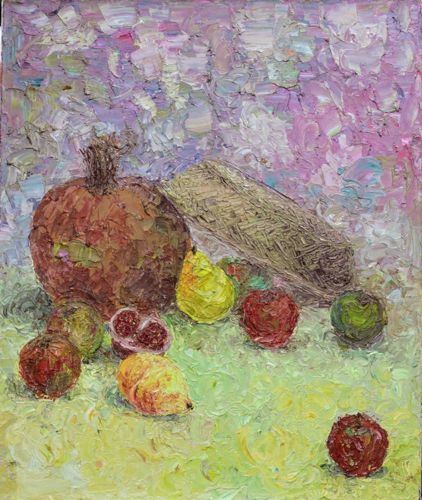
Impasto Still Life with Fruit and Loaf

Fine Art - Paintings

AI Estimated Value

·Not an official valuation·Verify before acting

$100 - $300

As of June 21, 2026

AI Item Analysis

·AI can make mistakes·Verify before acting
This is an original oil (or possibly heavy acrylic) painting on what appears to be a vertical canvas or panel. The artwork is characterized by an extreme impasto technique, where thick layers of paint are applied with a palette knife to create a high-relief, sculptural texture. The composition is a classic still life featuring an array of fruit including pomegranates, apples, and a pear, alongside a rustic loaf of bread. The color palette is vibrant, utilizing a varied background of pastel pinks, purples, and blues that contrast with the earthy browns of the pomegranate and the bright yellow-greens of the foreground table or surface. Notable is the artist's use of short, rhythmic strokes that catch the light, adding a dynamic quality to motionless objects. While the artist is currently unknown, the style is reminiscent of mid-to-late 20th-century Neo-Impressionism or modern Expressionism. The condition appears stable with the heavy paint layers intact; however, such thick applications are prone to cracking or 'micro-craquelure' over time. No visible signature is present on the front, which is common for studies or works by emerging artists of this period. The craftsmanship exhibits a confident handling of the medium and an emphasis on the tactile quality of the paint as much as the subject matter itself.

AI Appraisal Report

·AI can make mistakes·Verify before acting
Based on my visual examination of the digital images provided, this appears to be an original mid-to-late 20th-century still life executed in a heavy impasto technique, likely oil or heavy-body acrylic on canvas or board. The work showcases a confident application of pigment using a palette knife, resulting in a high-relief, sculptural surface texture that aligns with Neo-Impressionist or Expressionist decorative trends. The vibrant interplay of pastel violets and pinks against the organic tones of the fruit and bread demonstrates a competent understanding of color theory, though the composition is somewhat traditional. The absence of a visible signature significantly limits the valuation, placing this piece in the category of decorative fine art rather than investment-grade collectibles. While the technique is skilled, without a known artist to peg to auction records, we must rely on comparable sales of anonymous, high-quality decorative vintage paintings. Similar vibrant impasto still life works from the 1960s-1990s typically sell in secondary markets (antique malls, regional auctions) within the low hundreds. Condition appears stable, though I must note that extreme impasto is highly susceptible to dust accumulation in the crevices and craquelure (cracking) as the thick oil dries over decades. An in-person inspection would be required to verify that the heavy paint layers have not begun to lift or separate from the substrate. Furthermore, physical examination under UV light would be necessary to rule out any modern overpainting or repairs. As it stands, the value is derived primarily from its aesthetic appeal and decorative impact.

Get your items appraised

Instant estimates of your treasures with AI-powered appraisals

Browse More Appraisals