AI estimate as of September 13, 2025 · verify with a professional before acting
AI-Generated · Verify before acting
Everything on this page is generated by AI for informational purposes only. AI can make mistakes — the AI may misidentify items or misattribute them (artist, maker, brand, designer, origin, era). This is not an official valuation and should not be used for insurance, sale, tax, estate, legal, or lending purposes — or any decision requiring a certified appraisal. It is not an authoritative claim about any person, brand, or rights holder — do not share or rely on it as a factual statement about a third party. Always consult qualified professionals before making financial decisions.
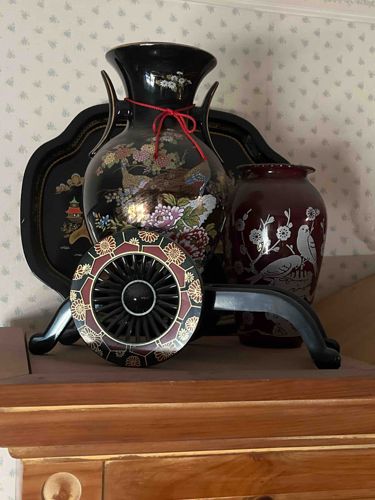
The primary item is a black lacquerware vase, approximately 10-12 inches tall, featuring a vibrant, multi-colored hand-painted or lacquered design depicting what appears to be peacocks amidst lush floral arrangements, including peonies and chrysanthemums, in shades of gold, silver, pink, purple, blue, and green. The vase has a flared rim and two elongated, wing-like handles extending upwards from its shoulders, which are tied together with a thin red string, possibly for decorative or symbolic purposes. The base color of the vase is a rich, glossy black. Behind the vase is a black lacquerware decorative tray or plaque, with a scalloped edge and raised sides, also adorned with gold and colored motifs, including pagodas and clouds, suggesting a Japanese or East Asian origin. To the right of the black vase, there is a smaller, maroon-colored vase with silver-colored bird and floral designs. In front of the larger vase, resting on what appears to be a separate stand, is a decorative round object, possibly a Japanese hand fan or a component of a larger decorative piece. This round object is black and maroon with intricate gold floral patterns forming a concentric design around a central grid-like feature. The stand supporting this round object is black with curved legs. All items exhibit a high level of craftsmanship, typical of traditional Japanese decorative arts. The lacquer appears generally well-preserved, with a noticeable sheen, indicating good care or minimal wear. No significant damage like chips, cracks, or extensive loss of lacquer is immediately visible from the image, but closer inspection would be required to confirm the full condition. The style points towards an East Asian (likely Japanese) decorative art aesthetic, possibly from the mid to late 20th century.
AI Appraisal Report
I have visually examined the provided image of the Japanese lacquerware vase and decorative tray ensemble. The primary black lacquerware vase, approximately 10-12 inches tall, features an elaborate multi-colored hand-painted or lacquered design depicting peacocks among peonies and chrysanthemums. Its flared rim and elongated, wing-like handles, tied with a red string, are notable. The black lacquerware decorative tray and other ancillary items, including a smaller maroon vase and a round decorative object, contribute to the overall aesthetic.
Based on visual inspection, the lacquer appears to be in generally well-preserved condition with a good sheen, suggesting careful maintenance. There are no immediately visible chips, cracks, or significant lacquer loss. The craftsmanship seems high, consistent with traditional Japanese decorative arts. The stylistic elements, such as the peacock motif and floral arrangements, definitely point to East Asian artistry, most likely Japanese. Given the apparent quality and design, I would estimate the period of creation to be mid to late 20th century.
Market conditions for such items show consistent demand, particularly for well-preserved pieces with intricate designs. Comparable items of this quality and period generally sell for several hundred dollars. The ensemble's completeness and artistic coherence enhance its market appeal.
However, it's crucial to note that this appraisal relies solely on photographic evidence. Absolute authenticity verification is not possible without a physical examination. An in-person inspection would allow me to assess the true condition of the lacquer, identify any repairs, and examine manufacturing techniques more closely. Furthermore, provenance documentation would be essential to confirm the item's origin, artist, and historical context. Scientific testing could verify the age and materials used. Without these, the authenticity and true market value, particularly for dating and maker attribution, remain subject to the limitations of visual inspection.