These notes were written by the person who submitted this item. Appraiser.AI has not verified them, and the AI's identification and estimate may rely on them.
AI Estimated Value
Not an official valuation
$40 - $70
AI estimate as of November 14, 2025 · verify with a professional before acting
AI-Generated · Verify before acting
Everything on this page is generated by AI for informational purposes only. AI can make mistakes — the AI may misidentify items or misattribute them (artist, maker, brand, designer, origin, era). This is not an official valuation and should not be used for insurance, sale, tax, estate, legal, or lending purposes — or any decision requiring a certified appraisal. It is not an authoritative claim about any person, brand, or rights holder — do not share or rely on it as a factual statement about a third party. Always consult qualified professionals before making financial decisions.
This analysis also relies on unverified notes provided by the user, which may be incomplete or inaccurate and could affect the result.
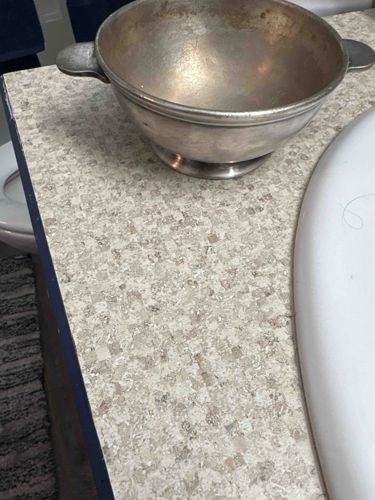
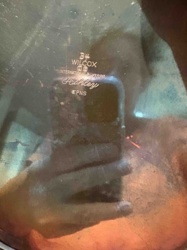
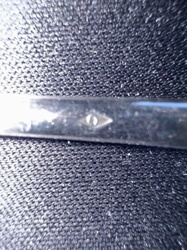
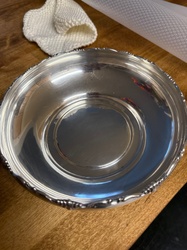
This is a silver-soldered, two-handled bowl, likely a sugar bowl or small serving bowl, manufactured by Reed & Barton, specifically from their 'The Madison' line, indicated by the '4S10' mark. The bowl has a classic, utilitarian design. It is constructed from a silver-soldered base metal, giving it a substantial weight and durability, typical of hotelware or institutional silver. The exterior and interior surfaces exhibit significant tarnishing, presenting a dull, oxidized silver-gray finish with areas of darker discoloration, especially within the crevices and around the handles. The overall condition suggests advanced age and lack of recent polishing, but no severe dents, dings, or major structural damage are immediately visible. However, fine surface scratches and scuffs are present across the surface, consistent with regular use and age. The bowl features two small, subtly curved handles attached just below the rim, integrated smoothly into the body of the bowl. The base is a solid, circular foot, providing stability. A prominent rim encircles the top edge of the bowl, adding a decorative and structural element. The quality of craftsmanship appears to be good, characteristic of Reed & Barton's reputation for producing durable and well-made silver and silverplate items. The '4S10' mark and 'silver soldered' designation confirm its construction and likely date range from the early to mid-20th century, a period when silver-soldered wares were popular for their resilience. The piece currently lacks the lustrous shine of polished silver, but this can likely be restored through proper cleaning and polishing.
AI Appraisal Report
I have examined the provided image and description of this Reed & Barton 'The Madison' Silver Soldered Two-Handled Bowl, marked '4S10'. My assessment is based solely on these provided materials, and I must emphasize that a full authentication and definitive valuation would require an in-person examination.
From the image and description, the bowl appears to be a genuine Reed & Barton silver-soldered piece, consistent with their designs and markings for durable hotelware from the early to mid-20th century. The '4S10' mark and 'silver soldered' designation support its authenticity within that context.
The condition, as described, indicates significant tarnishing and surface scratches consistent with age and use, but no major structural damage. While tarnishing can be removed, deep scratches could impact its aesthetic appeal, even after polishing. This item is not solid silver but rather silver-soldered, which means it has a layer of silver over a base metal, making it less valuable than sterling silver.
The market for silver-plated and silver-soldered tableware, particularly utilitarian pieces like this, is generally stable but not exceptionally strong for individual items unless they possess unique historical provenance or exceptional artistry. Comparable Reed & Barton silver-soldered bowls in similar condition typically sell in the $40-$70 range on secondary markets. Demand for such pieces is modest, driven mainly by collectors of specific patterns or those seeking durable vintage serving ware. Rarity is not a significant factor here; Reed & Barton produced these items in quantity.
Factors significantly impacting value include the 'silver-soldered' nature rather than sterling, the current tarnished state (though cleanable), and the lack of unique decorative elements. For full authentication and to rule out any potential alterations or reproductions, I would need a physical inspection to assess weight, test the metal composition, and examine the craftsmanship and marks under magnification. Provenance documentation would also enhance its value but is not typically available for this type of item.