AI estimate as of September 3, 2025 · verify with a professional before acting
AI-Generated · Verify before acting
Everything on this page is generated by AI for informational purposes only. AI can make mistakes — the AI may misidentify items or misattribute them (artist, maker, brand, designer, origin, era). This is not an official valuation and should not be used for insurance, sale, tax, estate, legal, or lending purposes — or any decision requiring a certified appraisal. It is not an authoritative claim about any person, brand, or rights holder — do not share or rely on it as a factual statement about a third party. Always consult qualified professionals before making financial decisions.
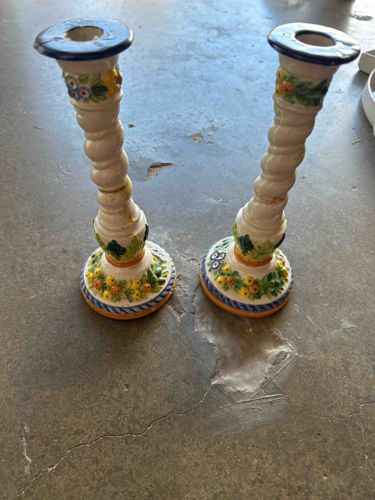
This is a pair of ceramic candlestick holders, likely made of earthenware or terra cotta, with a white glazed finish and hand-painted decorations. Each candlestick features a twisted or fluted column design, giving a sense of organic movement. The primary colors in the decoration are shades of yellow, blue, and green, depicting floral motifs and foliage, particularly around the base and at the top of the column just below the candle cup. The bases are circular and substantial, adorned with a border pattern that resembles a blue and white braided rope, accented with an orange or ochre outer rim. The candle cups themselves are simple, open forms with a dark blue rim, showing some residue or wear inside from previous use. The overall aesthetic suggests a possible Italian Majolica or similar folk-art inspired style. The craftsmanship appears to be reasonably hand-executed, evidenced by the slight irregularities in the painting and the molded form. Visible condition issues include some general wear and tear, minor abrasions, and what appears to be a slight discoloration or darkening of the white glaze in some areas, indicative of age and use. There are no immediately obvious chips or cracks, although closer inspection would be required. The decorative elements are vibrant and characteristic of Mediterranean or rustic European pottery from the mid-20th century.
AI Appraisal Report
Based on my visual examination of the provided image, this pair of ceramic candlestick holders appears to be a charming decorative item, likely from the mid-20th century, consistent with folk-art inspired styles such as Italian Majolica. The twisted column design and hand-painted floral motifs in yellow, blue, and green, along with the distinctive blue and white braided rope border, contribute to their aesthetic appeal.
In terms of condition, I observe general wear and tear, minor abrasions, and some discoloration of the white glaze, which is typical for items of this age and material. The residue within the candle cups also indicates prior use. While no obvious chips or cracks are apparent from the image, a physical inspection would be crucial to confirm their structural integrity and identify any hairline cracks or repairs.
From a market perspective, comparable hand-painted ceramic candlestick holders of this vintage and style typically fall into the modest decorative arts category. Demand for such items is generally steady, driven by collectors of rustic or Mediterranean decor, but they are not exceptionally rare. Factors impacting value include the hand-painted nature, the appealing design, and their being a complete pair. However, the lack of a prominent maker's mark (not visible in the image) and the commonality of similar production in Italy or Southern Europe during that period limit their high-end collectible appeal.
It is important to note that my assessment of authenticity is limited by viewing images alone. While the style strongly suggests a specific origin, full authentication would require in-person examination to check for firing marks, specific glaze characteristics, and any hidden repairs. Provenance documentation, if available, would also significantly aid in confirming their history and origin.