AI estimate as of August 21, 2025 · verify with a professional before acting
AI-Generated · Verify before acting
Everything on this page is generated by AI for informational purposes only. AI can make mistakes — the AI may misidentify items or misattribute them (artist, maker, brand, designer, origin, era). This is not an official valuation and should not be used for insurance, sale, tax, estate, legal, or lending purposes — or any decision requiring a certified appraisal. It is not an authoritative claim about any person, brand, or rights holder — do not share or rely on it as a factual statement about a third party. Always consult qualified professionals before making financial decisions.
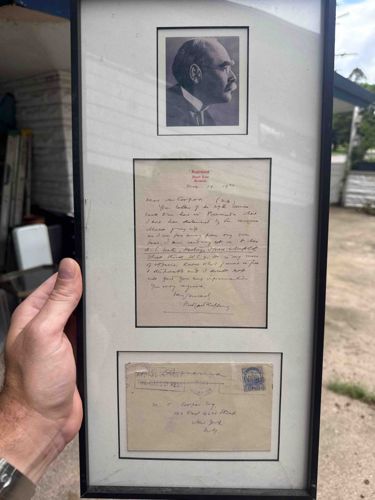
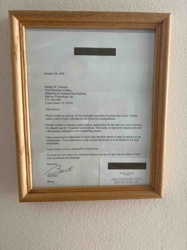
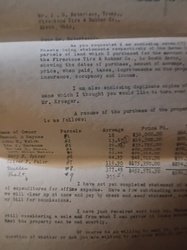
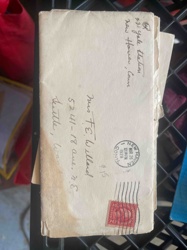
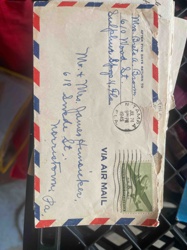
This item is a framed display featuring a photographic portrait of Rudyard Kipling, an original handwritten letter signed by Kipling, and the corresponding addressed envelope. The overall piece is housed within a black rectangular frame with a white matte board, creating three distinct openings for the individual components. The top section contains a monochromatic photographic print of Rudyard Kipling, depicting him in profile, facing right, with a stern yet thoughtful expression, and his characteristic mustache visible. This appears to be a formal portrait. Below the portrait, the central section displays a handwritten letter on what appears to be aged paper, possibly cream or off-white in color, with a faint red letterhead 'Bateman's Burwash Sussex' and the date 'June 17 1910'. The script is clear but shows signs of age, with some areas appearing slightly faded or less distinct. The bottom section of the display showcases an addressed envelope, also appearing aged and possibly discolored. It features a visible blue postage stamp in the upper right corner and handwriting for the recipient's address. The envelope's creases and slight yellowing suggest its age and original use. The entire assembly is protected by glass, which reflects some ambient light, but the contents are generally well-preserved. There are no obvious tears or major damage to the paper components, although the natural aging process is evident through slight discoloration and potential foxing that cannot be fully assessed from the image. The framing itself appears sturdy, with a clean, simple black finish, indicating a focus on the historical documents within. The craftsmanship of the framing seems professional, aiming to preserve and present these valuable artifacts. The historical significance of Rudyard Kipling, a Nobel laureate, imbues this framed piece with considerable intellectual and potential monetary value.
AI Appraisal Report
Upon examining the framed Rudyard Kipling memorabilia, my assessment is based on the visual information provided. The collection, comprising a photographic portrait, a handwritten letter dated June 17, 1910, on 'Bateman's' letterhead, and a corresponding envelope, presents as a cohesive and historically significant artifact. The visual characteristics of the ink, paper aging, and Kipling's signature appear consistent with known authentic examples from this period. The 'Bateman's' letterhead is a crucial positive indicator, as it was Kipling's residence. The condition is good, with expected age-toning and potential light foxing, but no major tears or damage are visible under the glass. The professional framing enhances its display value and likely aids in its preservation.
The market for A-list literary autographs, especially from Nobel laureates like Kipling, remains robust. Single signed letters from Kipling can fetch anywhere from $400 to over $1,500, depending heavily on content. Letters with significant literary or personal content command the highest prices. This complete grouping with a portrait and envelope is particularly desirable and commands a premium over a standalone letter.
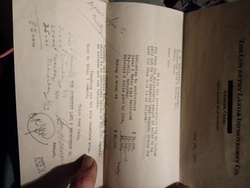
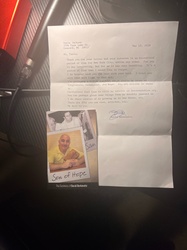
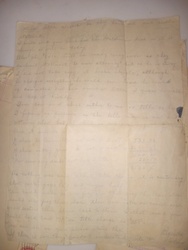
However, this appraisal is provisional. A definitive valuation hinges on full authentication, which is impossible from images alone. A physical, in-person examination is required to assess the paper stock, ink properties, and watermarks. Furthermore, reviewing any accompanying provenance or a Certificate of Authenticity (COA) from a reputable source like PSA/DNA or JSA would be essential to confirm the signature is not a forgery or secretarial. The content of the letter, which cannot be read from the image, is the single most significant variable; a mundane note versus a discussion of his work could alter the value by thousands.